
Ebm7/D#m7 chord
Root position: The most common shape: the lowest note is the root named in the chord, with the other chord tones stacked above it.
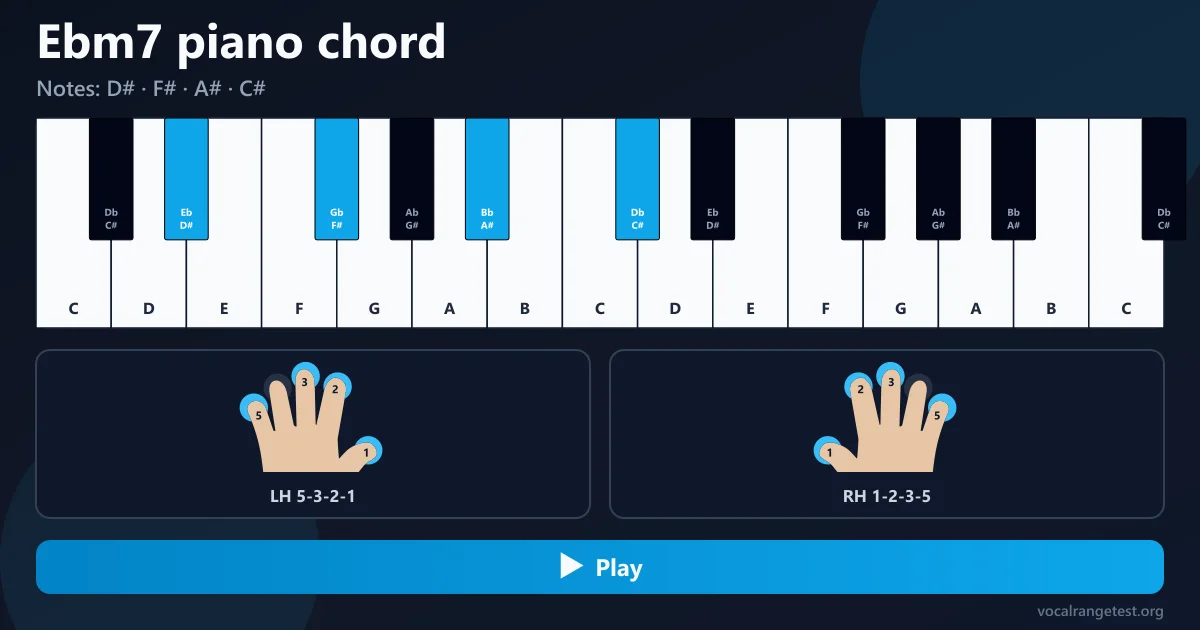
Notes: D# · F# · A# · C#
Voicing: 1 / 4
Fingering
Left hand: 5-3-2-1
Right hand: 1-2-3-5
Root
Chord type
Root position & inversions
D#m7 chord piano — four notes guitar charts love to spell in sharps, even when the flat spelling is sitting on the same keys
A D#m7 chord piano grip is a minor triad with a soft seventh on top: D#, F#, A#, and C#. On the keyboard that cluster lives mostly on black keys, which is why the chord can feel “thick” before it feels musical. The same sound shows up on flat-key sheets as Ebm7 chord piano writing—Eb, Gb, Bb, Db—because enharmonic twins share pitches, not letter names. Guitar tabs and sharp-key pop charts often print D#m7; jazz and concert charts in flats often print Ebm7. This page treats them as one colour you can hear online, break into an arpeggio, finger with either hand, and walk through inversions and alternate bass without arguing about spelling first.
When D#m7 gets called (and what the colour usually does)
Writers reach for D#m7 when a plain minor triad feels too closed. The extra C# (or Db in flat spelling) opens a little air at the top and makes the harmony want to move instead of sit. In the key of D# minor—or its flat twin Eb minor—D#m7 often works as i7: home, but softer than a bare triad. In F# major / Gb major it shows up as vi7 under vocals that need bittersweet support without full tragedy. Neo-soul pads, R&B bridges, film underscores, and sharp-side guitar arrangements all lean on it when the neighbourhood already thinks in sharps. Emotionally it tends to read as dusk with a little room left—cooler than Am7 on white keys, less clenched than three-note Ebm / D#m, not as dense as a jazz voicing piled with 9ths. If you are browsing key of d#m7 chords piano ideas, start with those two jobs (i7 and vi7); they cover most real sheets.
Interval-wise you are stacking root, minor third, perfect fifth, and minor seventh. The minor third (D# to F#) sets the shade; the minor seventh (D# to C#) is what stops the chord from feeling finished. Drop the seventh and you are back to a darker triad. Raise the third and you leave minor colour entirely. On this site the diagram is tied to piano samples: hear the full stack, then split it so each tone lights in order. That listen-and-break-apart loop matters more on black-key sevenths than on tidy white-key shapes, because crowding four close keys is how the seventh disappears into mud. Fingering, inversions, and alternate bass stay on the same page so d#m7 in piano practice is about sound and hand shape—not hunting three different websites for one chord.
Spelling is paperwork; the keys are shared
D#m7 and Ebm7 are the same pitches under different letter names. Learn the sound once. Then read whichever spelling your chart prefers without panic.
The seventh is the personality, not an optional decoration
If C# (or Db) goes missing or gets swallowed, you only have a dark triad. Chord mode proves the soft seventh; arpeggio mode makes you hear it arrive.
Workbench features that static posters skip
Click-to-hear chord or arpeggio, left/right fingering, inversions, and alternate-bass options live together here—so rehearsal time goes into listening and placement instead of decoding a mute image.
A D#m7 workbench you can actually hear
Printed grips freeze one hand shape. Here the diagram stays linked to piano sound, fingering updates, inversions, and slash bass—so you can check the soft minor-seventh colour by ear before you force a stretch.

Hear the stack, then take the seventh apart
Play a full D#m7 when you want the complete bittersweet ring. Switch to arpeggio when you need to isolate whether the seventh is speaking, or whether soft fingers have thickened the triad and blurred the colour. Playback follows the voicing on screen, so an inversion or alternate-bass shape matches the notes you see. That combination—online listening, broken-chord listening, fingerings, inversions, and alternate bass—is the practical difference between a poster and a page you can practise with.
- Online piano samples for block chord or arpeggio
- Left- and right-hand fingering that updates with the voicing
- Inversions for walking bass and softer handoffs
- Alternate-bass (slash) shapes when the chart puts a different note underneath
- Ebm7 spelling recognised as the same sound—one page, two chart languages
How to play D#m7 chord piano

1. Lock the four pitches before you stretch
Find D#, F#, A#, and C# on the diagram (or Eb–Gb–Bb–Db if you think in flats). Confirm each pitch before you mash the black-key span. Crowding is the usual failure mode: two fingers sharing almost the same key, or a soft fingertip spilling onto a white neighbour. Use the lit keys as a map, not a speed challenge.

2. Match your blend to the reference
Play the four notes yourself, then tap chord mode on the page. Listen for whether the seventh sits inside the colour or vanishes under a heavy triad. If the chord suddenly feels closed and triad-only, the top tone is the first suspect. Rebalance—often by lightening the fifth—until the soft seventh reads clearly.

3. Arpeggiate until the shape stops being a black-key smear
Switch to arpeggio and watch the tones light in order. Broken playback is how many players finally hear C# as part of the chord’s job, not as an optional add-on. Slow down until your own broken pattern matches the page. Clean D#m7 beats a loud, unclear cluster every time.

4. Move the bass through inversions
Open the voicing controls and step out of root position. First and second inversion change which chord tone sits on the floor while the quality stays D#m7 / Ebm7. Third inversion parks the seventh itself underneath—a favourite when a bass line wants a soft handoff into the next harmony. Hear each shape as a block chord and as an arpeggio so the new lowest note is obvious.

5. Preview alternate bass when the slash is not a chord tone
Some charts keep this minor-seventh colour in the right hand while the bass walks outside the strict inversion set. Use the alternate-bass options to preview that mismatch: same upper colour, different gravity underneath. It is a common studio trick and a common panic for players who only drilled root position.
6. Put D#m7 in a key instead of drilling it in silence
Sit on it as i7 in D# minor / Eb minor under a slow melody. Or treat it as vi7 next to F# / Gb major and walk a short progression so your ear hears the shade beside a brighter tonic. That is how key of d#m7 chords piano study sticks—context remembers what isolated grips forget. Come back to this page whenever you need the large diagram and the listen-and-break-apart tools again.