
C#m7/Dbm7 chord
Root position: The most common shape: the lowest note is the root named in the chord, with the other chord tones stacked above it.
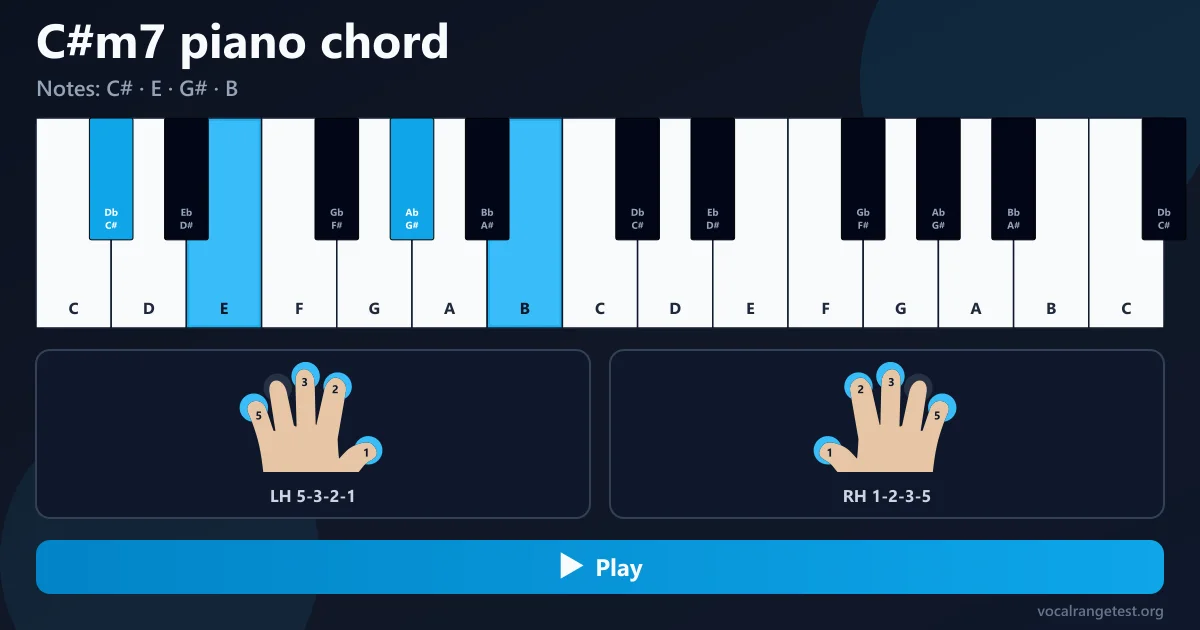
Notes: C# · E · G# · B
Voicing: 1 / 4
Fingering
Left hand: 5-3-2-1
Right hand: 1-2-3-5
Root
Chord type
Root position & inversions
C#m7/Dbm7 chord piano — four tones that sit soft under a melody instead of shoving the harmony forward
A C#m7/Dbm7 chord piano shape is a minor triad with one extra step: C#, E, G#, and B. The first three notes give you cool minor colour; B turns that triad into a minor seventh — smoother, more “finished-but-open” than a plain C#m, and nowhere near as pushy as a dominant seventh with a major third. Players searching C#m7 piano chord and players hunting a Dbm7 piano chord are listening for the same four pitches; charts only disagree about sharps versus flats. This page keeps you on that one minor-seventh colour so you can hear the stack online, break it into an arpeggio, check left- and right-hand fingerings, and walk through inversions and alternate bass without treating a mute diagram as gospel.
Where C#m7 (or Dbm7) earns its keep — and what the ear usually hears
Songwriters park this grip where minor needs room to breathe. In B major, C#m7 is the classic ii7 — the chord that slides into F#7 and then home to B in countless jazz and pop ii–V–I lines. In E major it often shows up as vi7, the relative-minor home that still feels plush because of the seventh. In A major it works as iii7, a gentle colour chord under a vocal that does not want a hard cadence yet. Loop-based R&B, neo-soul, and lo-fi progressions lean on minor sevenths for bars at a time; C#m7 fits when the track already lives on sharp-side ink, while a Dbm7 piano chord spelling shows up when the rest of the chart is drowning in flats (think Ab-major neighbourhoods, Db-minor ballads, or brass-friendly books). Emotionally the chord reads intimate and slightly nocturnal — minor warmth without the unfinished shove of a dominant. Compared with bare C#m, the added B softens the corners. Compared with C#7, the middle note is E instead of F, so the whole mood flips from “lean forward” to “settle in.”
Theory on one line: minor third + perfect fifth + minor seventh above the root. On the keyboard that means you must own E as deliberately as you own C# — raise it to F (E#) and you have left minor seventh territory for something brighter and wrong for the label. Flat-key spellings write the twin as Db–Fb–Ab–Cb; your fingers still hit the same keys. If you are mapping C#m7 in piano arrangements, learn the sound first, then match whatever symbol the sheet actually printed. Real left-hand writing rarely stays in root position. Expect C#m7/E when the third is the floor, C#m7/G# when the fifth carries the bass, and C#m7/B when the seventh itself sits underneath for a darker, stacked landing. Hearing block chords and arpeggios on this page makes those slash marks audible before your hand commits.
E is the hinge of the minor colour
C#–E–G# is the minor triad. Keep E natural. If that middle tone drifts up, you are no longer playing the minor seventh the chart asked for — you are edging toward major-third harmony.
Sharp ink versus flat ink, same night-drive sound
C#m7 keeps the bar readable in sharp keys; Dbm7 keeps flat-key charts consistent. The ear does not care which accidental set you wrote — the hand still presses the same four keys.
Listen, break it down, then move the bass
Here you can hear real piano samples as a full chord or an arpeggio, read fingerings for each hand, and flip inversions or alternate bass so practice time goes into placement and colour, not guesswork from a static picture.
Work the C#m7 piano chord with playback, fingerings, and movable bass
A silent JPEG will not tell you whether B is actually speaking under the triad. This diagram is tied to piano samples, left/right fingerings, inversions, and alternate bass — so you judge the minor-seventh blend by ear before you take it into a progression.

Hear the minor seventh whole, then hear it in pieces
Block mode stacks C#, E, G#, and B so the soft minor-seventh colour is obvious in one hit. Arpeggio mode walks those tones in order when you need to catch a weak E or a missing B — the two notes players most often thin out when the hand gets lazy. Whatever inversion or slash you select is what you hear, not a generic root-position loop. That habit matters in ballads and neo-soul grooves where the seventh is half the atmosphere: if B disappears, you are left with a plain triad that feels thinner than the chart intended.
- Real piano samples for stacked chord or rising arpeggio
- Fingerings for left and right hand that follow the voicing
- Root position plus C#m7/E, C#m7/G#, and C#m7/B
- Alternate bass options when a lead sheet writes an unexpected slash
- One minor-seventh sound whether the page says C#m7 or Dbm7
How to play C#m7 chord piano

1. Plant the minor triad, then add B on purpose
Find C# among the black keys near middle C. Place E on the white key a minor third above, G# on the next black key, then B a whole step under the root’s octave. Right hand often sits comfortably on 1–2–3–5; left hand commonly 5–3–2–1. Build C#–E–G# first if the stretch feels new, then add B so the seventh is a decision, not an accident. If the chord suddenly brightens like a major-ish sound, check that E did not creep up. If it sounds like bare C#m, you never seated the B.

2. Keep the four attacks even — soft does not mean weak
Minor sevenths fall apart when the third or seventh is ghosted. Aim for an even blend: E carries the minor identity, B supplies the seventh’s velvet without covering G#. Neighbour black keys under floppy fingertips are the usual mess when the grip turns muddy. Once the shape is stable, trigger the block chord on this page and match it — you want that cool, settled minor-seventh pad, not a slammed cluster and not a timid triad with a polite B trailing behind.

3. Use arpeggio mode until C#–E–G#–B is muscle memory
Watch each key light as the pitch rises. That sequence is the fastest way to separate C#m7 from C#m (no seventh), from C#7 (major third on F), and from C#maj7 (different seventh quality entirely). Slow down wherever a finger hesitates. This is where C#m7 in piano practice stops being “four keys I memorized” and starts sounding like the chord on the sheet.

4. Walk the inversions: C#m7/E, C#m7/G#, C#m7/B
Open the inversion controls. C#m7/E puts E in the bass — extremely common in smooth voice-leading when the line rises through the third. C#m7/G# parks the fifth underneath for a more open floor that still reads as minor seventh. C#m7/B puts the seventh on the bottom for a darker stack you hear in R&B left hands and jazz ballads. Listen in both chord and arpeggio modes so the new bass note is unmistakable before you copy the fingering. Those slash labels are still one C#m7/Dbm7 harmony.

5. Check alternate bass when the chart refuses root position
Some lead sheets keep the minor-seventh colour above while the bass walks to a note outside the basic inversion set. Preview those alternate-bass shapes here until the new floor makes sense by ear. Same four chord tones on top, different gravity below — that is exactly where players who only drilled root position get lost mid-song.
6. Put it in a progression so the colour has a job
When you study key of C#m7 chords piano in context, start with jobs charts actually assign: ii7 moving toward F#7 and B, vi7 holding space in E major, or a looping i7 groove in C# minor / Db minor ballads. Hold the chord, then move to the next symbol on a real sheet and notice how little “push” this minor seventh needs compared with a dominant. Come back to this page for the large diagram, the hear-and-break-down tools, the fingerings, and the inversion set whenever the next arrangement respells the same sound as Dbm7 or throws a new slash at you.