
Bm7 chord
Root position: The most common shape: the lowest note is the root named in the chord, with the other chord tones stacked above it.
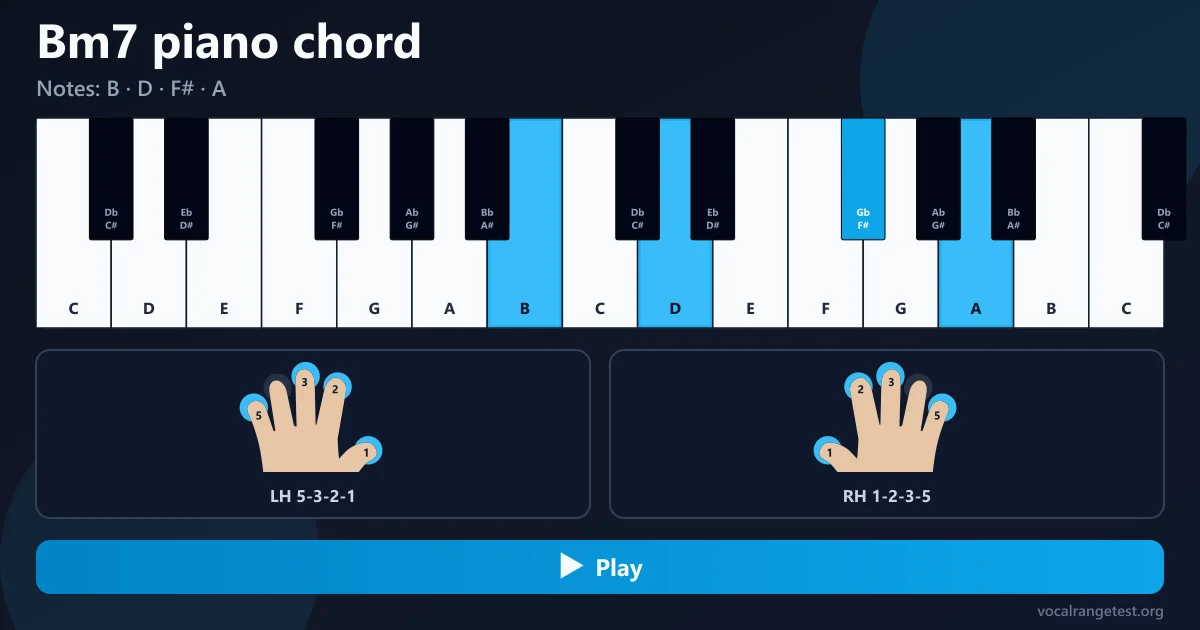
Notes: B · D · F# · A
Voicing: 1 / 7
Fingering
Left hand: 5-3-2-1
Right hand: 1-2-3-5
Root
Chord type
Root position & inversions
Alternate bass
Bm7 piano chord — B minor with the lid cracked open
A Bm7 piano chord is B, D, F#, and A. Start from B minor (B–D–F#) and add A on top — the minor seventh. That extra note is why Bm7 feels cooler and roomier than a plain minor triad. The sadness is still there, but it has somewhere to sit. You will hear this shape constantly in jazz turnarounds, R&B loops, indie ballads, and quiet pop bridges. This page is only about Bm7: listen to real piano samples, split the chord into single notes, check fingerings, then move through inversions and alternate bass until the symbol on your sheet matches a sound you trust.
Where Bm7 shows up in real music (without the jargon fog)
Writers grab Bm7 when they want minor color that does not sulk. Plain B minor can feel heavy or dramatic. Bm7 softens that weight — more late-night playlist than funeral march. In A major, Bm7 is the classic ii chord, so it often walks into E7 (or E) on the way home to A. In D major it can work as vi and sound reflective without getting stuck. Jazz players lean on Bm7–E7–Amaj7 all the time. Neo-soul and R&B love it in repeated grooves because the seventh keeps the harmony from sounding thin. Pop writers swap it in when a straight Bm triad feels too blunt under a vocal.
If you searched Bm7 in piano or key of Bm7 chords piano, you are probably after straight answers: the four notes, how it differs from Bm or B7, and what a chart means when it writes Bm7/A. Quick trap to avoid: B minor is B–D–F#. Leave out A and you lose the seventh color. Raise D to D# and you leave minor territory entirely. Root position is the clearest place to hear all four tones lined up. Arrangements rarely freeze there — bass lines move through Bm7/D, Bm7/F#, and Bm7/A, and sometimes ask for a slash bass that is not one of those. Hearing the full stack beside an arpeggio turns those labels into something your ear can approve before your hands copy them.
A is the note that opens the chord
Without A you have B minor. With A, the sound widens and softens. If your Bm7 still feels tight or incomplete, that top note is the first place to look.
Minor, yes — but not automatically gloomy
Bm7 can sound cool, thoughtful, smoky, or gently sad depending on tempo and context. Calling it “the sad chord” is too small. It is minor with room to breathe.
Slash marks change the floor, not the chord name
Bm7/D, Bm7/F#, and Bm7/A keep the same upper color while the lowest note moves. Charts use them for smoother bass motion without renaming every bar.
Tools that make a Bm7 piano chord audible — not just drawable
Printed charts show dots. They cannot tell you whether D and A are really speaking. On this page you click to hear the voicing, break it into an arpeggio, follow left- and right-hand fingerings as the bass shifts, and preview inversions or alternate bass before you commit at the keyboard.

One chord page: full hit, note split, and bass changes
Use chord mode when you want the whole Bm7 color at once. Flip to arpeggio when B–D–F#–A still smear together — especially handy while A feels like an afterthought, or while your hand keeps defaulting to a three-note B minor shape. Playback tracks the inversion or slash you selected, so a Bm7/A piano chord voicing sounds like the actual lowest note on screen, not a recycled root-position demo. Fingerings update with the shape, which helps the second a chart asks for a walking bass or a tighter right-hand voicing under a melody.
- Click-to-hear piano — block chord or arpeggio
- Left- and right-hand fingerings that follow the voicing
- Root position plus Bm7/D, Bm7/F#, and Bm7/A
- Alternate bass options when the slash sits outside the usual set
- Free browser practice — no signup
How to play Bm7 chord piano

1. Find B minor, then park A above it
Around middle C, play B, D, and F# — the B minor triad. Then add A on the white key above G#. Right hand often uses 1–2–3–5; left hand commonly mirrors with 5–3–2–1 going up. If it only sounds like B minor, A is missing or buried. If it sounds major or “bluesy dominant,” check whether you accidentally raised D or changed A.

2. Balance the minor third and the seventh
D gives you the minor quality. A gives you the seventh that makes the chord feel complete. Play all four notes evenly so neither disappears. Match your hand against the sound on this page until you hear smooth minor color — not a thin triad, not a muddy cluster.

3. Walk the notes until nothing is fuzzy
Arpeggio mode lights keys one at a time. Slow B–D–F#–A is the quickest way to stop confusing Bm7 with Bm, B7, or a random four-note grab. If A always lands late, stay slow until it feels like part of the chord, not an optional add-on.

4. Shift the bass through the common inversions
Try Bm7/D for a less heavy bottom. Bm7/F# opens the middle of the chord. A Bm7/A piano chord puts the seventh underneath — third inversion — which often feels especially smooth in descending bass lines and quiet accompaniment. Hear each version stacked and broken so the new lowest note is obvious before you copy the grip.

5. Preview odd slash basses when the chart gets creative
Sometimes the upper structure stays Bm7 while the bass note is not D, F#, or A. Use the alternate-bass previews here until that new gravity feels familiar. Same minor-seventh color on top, different foundation underneath.
6. Drop it into a progression you already know
Practice Bm7 as ii before E7 in A major, as a soft minor color in D, in a neo-soul loop, or under a verse that needs depth without drama. Hold Bm7, move to the next harmony, and notice how different it feels from plain Bm. Songs teach the mood faster than isolated shapes; return here whenever you need the large diagram, inversion set, and hear-and-split tools for a new voicing.