
Eb9/D#9 chord
Root position: The most common shape: the lowest note is the root named in the chord, with the other chord tones stacked above it.
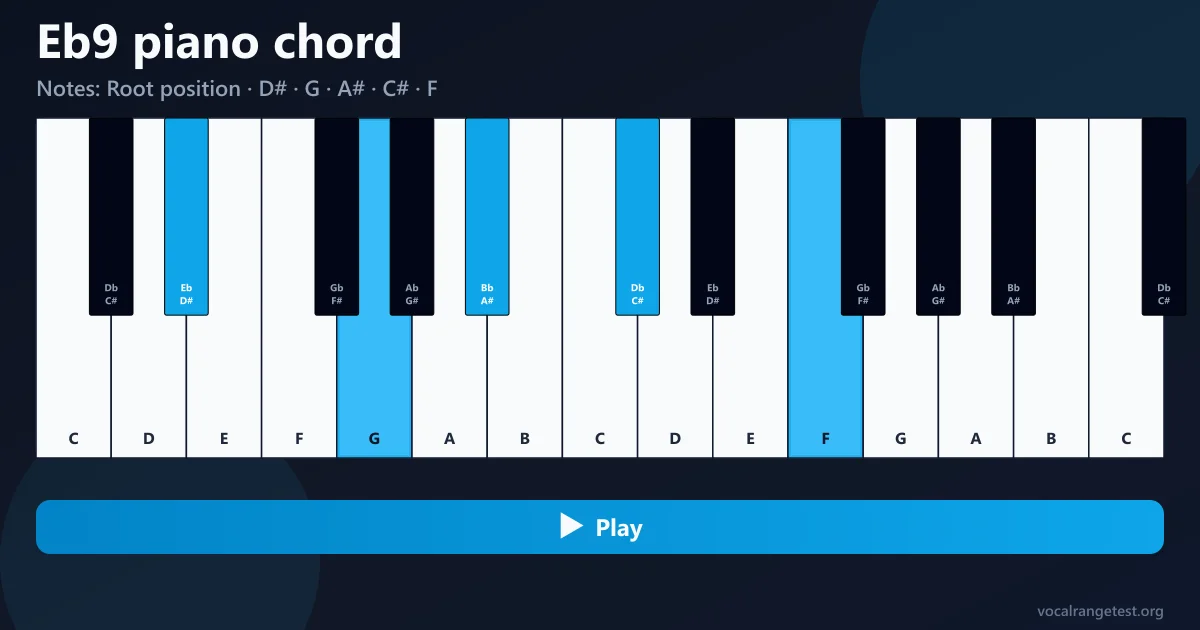
Notes: D# · G · A# · C# · F
Voicing: 1 / 4
Root
Chord type
Root position & inversions
Two-hand voicing
Eb9 piano chord — Ab-major’s favourite V9, also spelled D#9 on sharp-side charts
An Eb9 piano chord is an E-flat dominant seventh with a major ninth on top. In plain note names that stack is Eb, G, Bb, Db, and F. Flat-key songbooks, horn parts, and gospel folders almost always keep that spelling. Sharp-side charts living in C#, F#, or G# may print the identical keys as a d sharp 9 piano chord: D#, F## (played as G), A#, C#, and E# (played as F). If you searched for an e flat 9 piano chord, you are in the right place — Eb9 and D#9 are two labels for one grip. Players usually arrive here because a lead sheet in Ab or Eb suddenly asks for five tones, not three, and a mute diagram cannot prove whether the F on top sweetens the chord or fights the singer. This page lets you hear real piano samples, peel the voicing into an arpeggio, check fingerings, and walk inversions before you trust the shape in a tune.
Why Eb9 shows up — and which traps catch non-specialists
Writers reach for Eb9 when a plain Eb7 feels blunt but a full thirteenth would be too much ink. In Ab major it is the classic V9: it leans hard toward Ab. In Bb major the same colour can dress II or a secondary dominant; in Eb blues it often parks as a stylish I9 under a chorus. The flat seventh (Db) is the note that keeps the chord dominant — swap it for D natural and you have flipped into Ebmaj9 territory, the floating “major 9” sound people sometimes mean when they type e flat major 9 piano chord. Another trap is treating Eb9 like “Eb major plus any high F.” That path is closer to Ebadd9, which keeps a major triad and skips the flat seventh. Emotionally the chord reads warm, slightly bluesy, and open on top: G keeps major brightness, Db refuses to settle, F polishes the ceiling. Hold Eb7 next to it and the seventh alone sounds stubbier; add F and the grip gains air without losing the pull toward Ab.
We built this tool because rehearsal time disappears when you only stare at a screenshot. Hit play for the full Eb9 stack, then switch to arpeggio mode so each tone lines up under your ear: root, third, fifth, flat seventh, ninth. Left- and right-hand fingerings update as you change voicing. Inversion controls put G, Bb, Db, or F in the bass so a slash mark becomes a sound you can approve, not a guess. Online listening, chord breakdown, fingerings, and inversions live on one free page — that is the practical difference between copying a picture and knowing the colour before the downbeat. Match the spelling to the room: brass books and flat-key pop prefer Eb9; sharp-key rehearsal charts sometimes keep D#9 so accidentals stay consistent. Your fingers press the same five keys either way.
Db is the traffic light
Keep Db and the chord still wants to resolve like a dominant. Change it to D natural and you have stepped into major-ninth territory — a different job on the page.
F is why the symbol says 9, not 7
Eb7 already has the pull. The ninth (F) is the extra polish arrangers want when the seventh alone feels too short or too dry.
Hear first, stretch second
Audition the stacked chord and the broken arpeggio here, lock a fingering, then try inversions. Colour judged by ear beats memorising a silent chart you never hear under a melody.
Eb9 chord on piano with live sound, breakdown, and inversions
A photo cannot tell you if the ninth sits sweetly above Db or turns muddy in the octave you chose. Preview the full grip, split it into an arpeggio, confirm fingerings, then move through inversions and alternate bass on the same page.

Hear the Ab-leaning stack, then isolate Db and F
Start with the full Eb9 so your ear learns the colour as one object — bright G, restless Db, polished F on top. Switch to arpeggio mode when you need to confirm you did not land on D natural by habit, and that the ninth is actually speaking (or C# and E#/F in D#9 spelling). Left- and right-hand fingerings follow each voicing, so the stretch you hear is the stretch you will practice.
- Real piano samples as a full chord or rising arpeggio
- Left- and right-hand fingerings that update with each voicing
- Root position plus inversions with G, Bb, Db, or F in the bass
- Alternate bass when a chart writes a slash outside the basic set
- Same ninth sound whether the sheet says Eb9 or D#9
How to play Eb9 chord on piano

1. Plant Eb7 first — especially the Db — then add F on purpose
Find Eb, G, Bb, and Db. That four-note grip is your dominant seventh; Db is the note beginners most often replace with D by accident. Add F above or beside the stack so the ninth has a clear seat. Thinking in sharps? Build D#, G, A#, C#, then F (covering E#). Play all five together once, then alone, until F feels chosen rather than leftover.

2. Decide how close F sits to Db
In a tight midrange voicing, F can sit right next to Db and feel thick. Soften the top note, open the spacing, or lift the ninth an octave for air. Thin Bb if the left hand already covers the fifth. Aim for a polished dominant colour that still leans toward Ab, not a five-note wall against the vocal.

3. Flip between e flat 9 and d sharp 9 labels without moving your hands
Use arpeggio mode to walk Eb–G–Bb–Db–F slowly, then at song tempo. Keep the fingers planted and rename the stack D#–G–A#–C#–F in your head. When either spelling reads cleanly, you stop freezing when a writer suddenly switches from flat ink to sharp ink mid-rehearsal.

4. Move the bass through G, Bb, Db, and F
Root position is only the passport photo. G in the bass (first inversion) often smooths a walk from Ab or C; Bb in the bass can feel like a pedal fifth under a right-hand ninth; Db in the bass leans hard into the dominant pull; F in the bass puts the colourful ninth underneath and can sound almost like a soft slash until the upper voices clarify Eb as the root. Audition each inversion here before muscle memory locks in.

5. Preview alternate bass when the chart wanders
Some arrangements keep an Eb9 symbol while the bass line leaves the basic inversion set. Preview that slash on this page: if the ninth colour still reads, keep your right-hand voicing; if it turns muddy, thin an inner voice or change inversion. Approving the sound first saves you from learning a stretch that fights the bass player.
6. Give the ninth a job inside a real key
In Ab major, treat Eb9 as V9 — it wants to fall home. In Eb major or Eb blues, try it as a dressier I-area colour. In Bb major it often colours II or V-of-V motion in R&B and gospel writing. Loop a short turnaround and swap plain Eb7 for Eb9 on the dominant: you will hear why arrangers grab the ninth when they want lift without stacking a full thirteenth.