
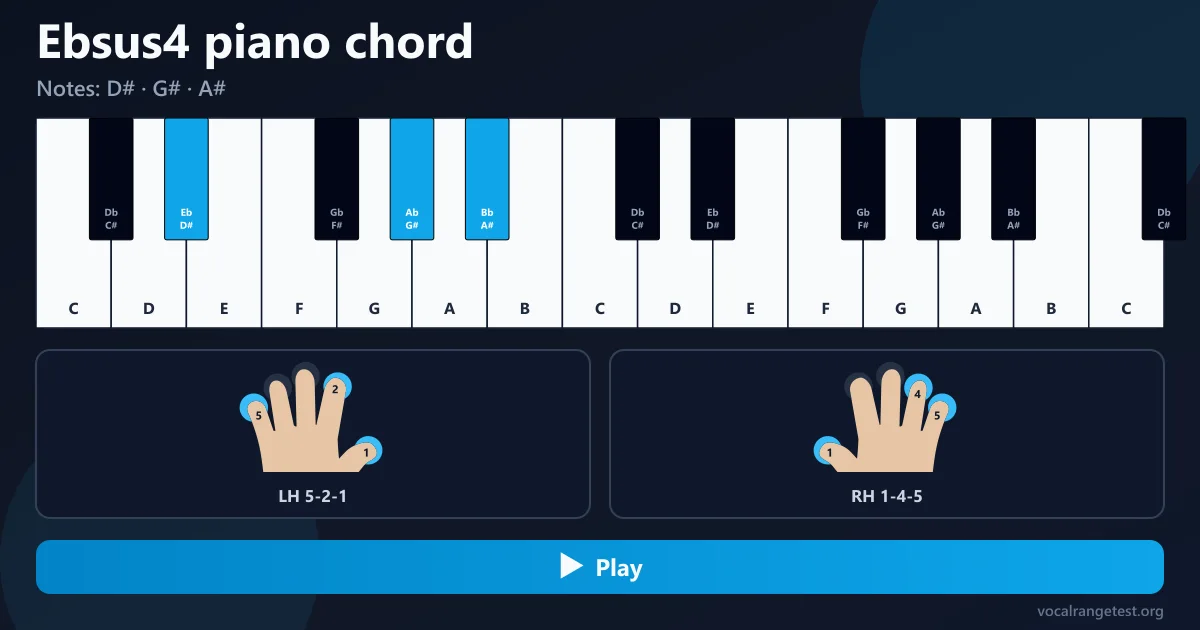
Ebsus/D#sus chord
Root position: The most common shape: the lowest note is the root named in the chord, with the other chord tones stacked above it.
Notes: D# · G# · A#
Voicing: 1 / 6
Fingering
Left hand: 5-2-1
Right hand: 1-4-5
Root
Chord type
Ebsus4
Ebsus2
Eb/D# sus chord piano for keys that live in flats
An Eb/D# sus chord piano grip is what happens when you keep Eb (or D#) and Bb (or A#) as the outer posts and refuse to play the plain major third. In its place sits either Ab (the fourth) or F (the second). Charts may stamp Ebsus, D♯sus, E♭sus4, or D#sus2; your hands meet one family of sounds. Players type eb sus piano chord, e flat sus chord piano, or a sharp spelling of the same idea—this page answers with a live keyboard instead of another mute PNG.
What is eb sus chord piano, without the jargon maze?
Plain Eb major is Eb, G, and Bb. The G is the smile—the note that tells your ear the chord is major. Take G away. Drop Ab into that middle slot and you have the everyday Ebsus4: Eb–Ab–Bb. Drop F instead and you have Ebsus2: Eb–F–Bb. Nothing in either stack is a major or minor third, so the chord will not commit to cheerful or gloomy on its own. It hangs. Songwriters borrow that hang when a lyric is still mid-sentence, when a horn section needs a soft cushion, or when a gospel groove wants one more beat before the major third returns.
Why Eb so often? Whole shelves of jazz standards, wind-band charts, and R&B ballads sit in Eb or Bb because singers and Bb instruments (trumpet, clarinet, tenor sax) are comfortable there. In Bb major, Eb is the IV chord—classic lift-into-chorus territory—and an Ebsus on that IV buys float before you plant G again. In Eb major itself, Ebsus colors the home chord so the downbeat does not feel like a door slamming shut. Sharp-key sheets may rename everything D#; the piano still lights the same physical keys. Learn the sound once, then match whatever spelling the PDF threw at you.
Ebsus4 — what most charts mean by a bare “sus”
Eb–Ab–Bb (enharmonic D#–G#–A#) is the default when a lead sheet only prints Ebsus. Ab sits right above the missing G, so resolving back to Eb major feels obvious and satisfying—the classic “held breath, then release” move in pop and worship writing.
Ebsus2 — wider color, softer gravity
Eb–F–Bb keeps the same outer posts and parks F in the middle. It often reads as more open and less cadential than sus4—handy under long melody notes, neo-soul pads, and film cues where you want air without telegraphing an immediate landing on G.
Brass-friendly keys, piano-friendly hands
Rehearsal rooms in Eb hand a lot of pad duty to the keyboard while horns take the melody. An Eb sus sits in a mixed black-and-white shape that is easy to grab once you know the posts. That practical job—holding the band’s harmony while someone else solos—is why this page exists as a hearing tool, not only a theory footnote.
Listen first, then peel the Eb/D# sus into pieces
Paper cannot tell you whether Ab or F is carrying the mood. On this tool you trigger piano samples as a full block or a rising arpeggio, glance at left- and right-hand fingerings, then flip through inversions and alternate bass so the same suspension can sit over a different lowest note.

Moments when an eb sus chord piano color earns its keep
Picture a ballad intro that should feel unfinished for eight bars. Picture a bridge where the singer holds one vowel and a plain Eb major would sound like the song already ended. Picture a horn soli that needs a soft carpet underneath. Those are Ebsus jobs. Producers also park it under two-chord loops so the loop breathes instead of marching. You do not need to name scale degrees first—if Eb major feels too “done” for the lyric, borrow the suspension; put the third back when the phrase resolves.
- Online piano playback for the whole chord or a note-by-note arpeggio—trust your ears, not only ink.
- Ebsus4 / D#sus4 and Ebsus2 / D#sus2 in separate groups so you can A/B the middle voice.
- Suggested fingerings for both hands on root-position shapes you can check at the bench.
- Inversions plus alternate-bass voicings when the arrangement wants Bb, Ab, or another tone underneath.
- Browser-ready—no app download and no login wall for a quick pre-rehearsal listen.
Three short passes to lock in an e flat sus chord piano grip

Plant Eb and Bb before you touch the middle
Find a comfortable Eb (or D#) and the Bb (A#) a fifth higher. Sus4 and sus2 share that frame. If the posts wobble, no middle note will convince anyone you are in the Eb family.

Slot Ab or F, then hear the fall into major
Place Ab between the posts for the chart-default Ebsus4. Play the block, then arpeggiate until every highlighted key has a voice. Switch to Ebsus2 with F in the middle and resolve both shapes into plain Eb (or D#) major. Notice which release snaps harder (often sus4→major) and which eases in (often sus2).

Shift the bass when the arrangement asks
Use the inversion and alternate-bass controls when you need the same suspended color with Bb, Ab, or another chord tone in the basement. That is how pads move through a real chart without resetting to root position every bar.