
Ebm9/D#m9 chord
Root position: The most common shape: the lowest note is the root named in the chord, with the other chord tones stacked above it.
Notes: D# · F# · A# · C# · F
Voicing: 1 / 4
Root
Chord type
Root position & inversions
Two-hand voicing
Ebm9(D#m9) piano chord — the dark minor stack with one bright ninth on top
Searchers who type Ebm9(D#m9) piano chord usually want three things right away: which keys to press, what the voicing should sound like before they commit hand shape, and whether the chart’s Ebm9 is the same sound as a D#m9 rewrite. This page answers those questions with a live keyboard, then stays useful after the first listen—fingerings, positions, inversions, and a plain-English walkthrough of how the chord is built.
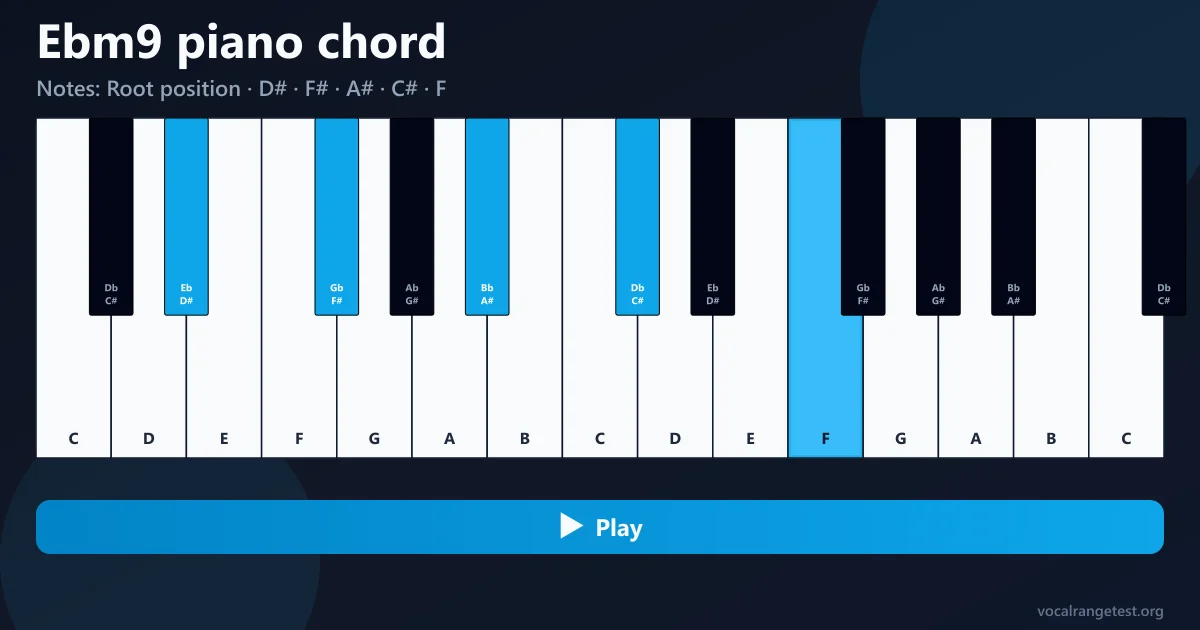
What people actually need from an Ebm9(D#m9) chord on piano
Ebm9 is a five-note colour: a minor triad on Eb, a flat seventh, and a major ninth. In flat spelling that is Eb–Gb–Bb–Db–F. On the same keys, a sharp chart may label the identical grip D#m9 (D#–F#–A#–C#–E#, which sounds as F on the piano). The quality people hear is not “just another minor chord.” The seventh keeps the harmony soft and jazz-leaning; the ninth (F) lifts the cloud so the voicing feels open instead of muddy. That is why neo-soul keys, quiet R&B pads, and film cues reach for Ebm9 when a plain Ebm or Ebm7 feels unfinished.
We built this tool because static chord diagrams stop at a picture. You can stare at five black-and-white keys and still misjudge the spacing, the hand split, or whether the ninth should sit in the right hand. Here you hear the full Ebm9 block, then break the chord into an arpeggio so each tone settles in your ear. Switch positions and inversions when the left-hand root fights the melody, or when a slash bass (for example Ebm9/Db) is what the chart actually wants. The goal is simple: leave the page able to play the chord, not only name it.
Five tones, one job: soft minor with air
Root, minor third, fifth, flat seventh, and ninth. Drop the F and you are back in Ebm7 territory; keep it and the chord breathes.
Ebm9 on the page, D#m9 in the sharp room
Same piano keys. Flat-key charts print Ebm9; sharp rewrites often show D#m9. Learn both labels so transposition does not trip you.
Hear first, then lock the fingering
Audition the block and the note-by-note split before you muscle a five-note grip. Your ear catches clashes your eyes miss.
Ebm9(D#m9) chord on piano — listen, split, and flip positions
One page for the sound, the note breakdown, left/right fingerings, and the inversions you actually use when the root position is too wide or too low.

Why this page is not another static chord chart
Most results for Ebm9 piano chord show a frozen diagram and a note list. Useful as a reminder—weak as a teacher. Our difference is interaction with real information gain: tap to hear the full chord, switch to arpeggio mode to isolate Eb, Gb, Bb, Db, and F one at a time, then compare root position against inversions and two-hand layouts. That loop mirrors how players actually learn a dense minor ninth: sound first, spacing second, hand choreography last. You also see when a chart’s “Ebm9” really wants a slash bass or a thinner upper structure under a singer. Free, in the browser, no account wall between you and the keys.
- Click-to-hear Ebm9 / D#m9 as a full piano block
- Note-by-note breakdown (arpeggio) for ear training
- Fingering diagrams for comfortable hand shapes
- Positions and inversions when root position fights the melody
- Slash-style bass options when the arrangement walks
- Works on phone or desktop—no install, no signup
How to play Ebm9(D#m9) chord on piano

1. Plant the Ebm7 skeleton, then add F
Start with Eb–Gb–Bb–Db under your hands. That is the minor-seventh frame. Place F above (or woven into the right-hand cluster) so the ninth speaks without crushing the third. If the voicing feels huge, keep the root and fifth in the left hand and let the right hand carry Gb–Db–F.

2. Listen to the block, then the breakdown
Play the full Ebm9 once so you catch the cloudy minor colour. Switch to the note-by-note split and sing or hum each tone. The F should feel like daylight on top of the darker stack—if it disappears, the ninth is buried or your balance is too left-hand heavy.

3. Match the chart spelling without changing keys
Reading D#m9? Same buttons on the keyboard. Mentally map D#=Eb, F#=Gb, A#=Bb, C#=Db, and the ninth as E#/F. Practice saying both names aloud while you play so rehearsal talk in sharp keys does not freeze you.

4. Move into inversions when root position crowds you
Root-position five-note grips get bulky fast in the mid range. Flip so a smoother bass tone leads—especially shapes that put Db or Bb underneath when the arrangement wants motion. Use the page’s inversion and position controls instead of guessing new stacks from scratch.

5. Thin the voicing under a vocal
If a singer already owns F or Gb, drop a doubled tone rather than smashing the full cluster. Keep the minor third and the ninth when you can; those two notes carry most of the “Ebm9” identity once the ear has heard the seventh.
6. Drop it into a key so the colour has a job
In Eb minor or Gb major contexts, Ebm9 often softens a i chord or colours a borrowed minor. Try it before resolving to Ab or Bb harmony and notice how the ninth wants to lean forward. Hearing that pull on this keyboard beats memorising theory labels alone.