
Ebdim/D#dim chord
Root position: The most common shape: the lowest note is the root named in the chord, with the other chord tones stacked above it.
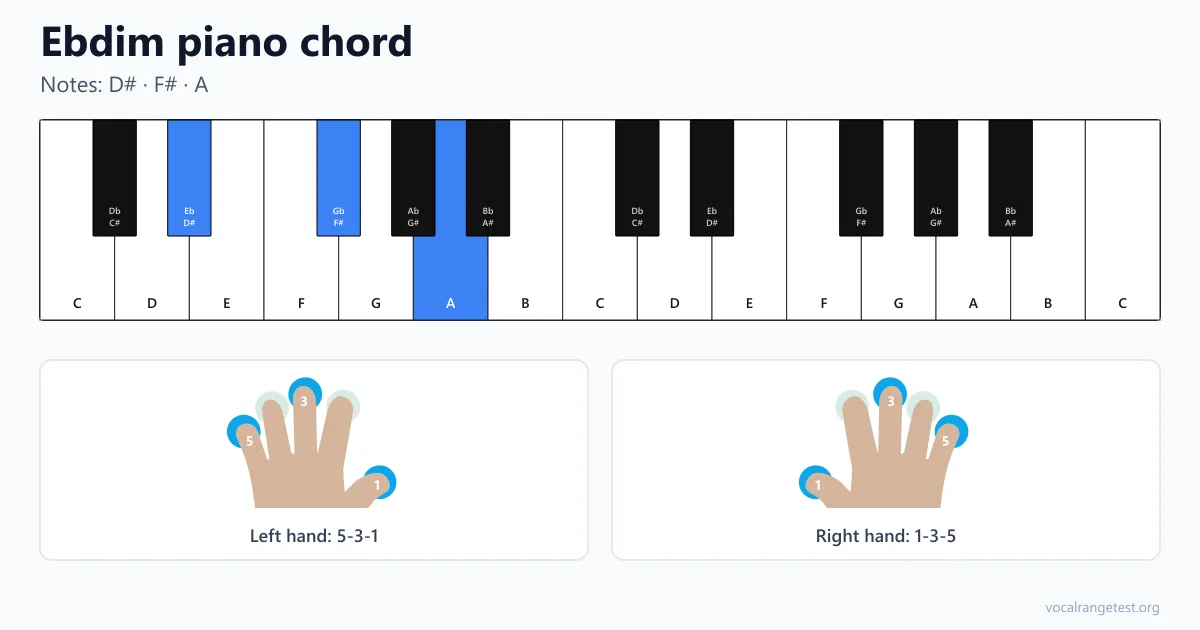
Notes: D# · F# · A
Voicing: 1 / 3
Fingering
Left hand: 5-3-1
Right hand: 1-3-5
Root
Chord type
Root position & inversions
Ebdim piano chord: flat-side ink, sharp-side twin, one restless grip
An Ebdim piano chord is the diminished triad built from the black-key root Eb (the same pitch as D#). Under your fingers the usual layout is Eb (or D#), F#, and A—two minor thirds stacked so a bare tritone sits between the outer notes. Horn charts and R&B sheets lean toward the flat name; rock and guitar PDFs often print a d#dim piano chord or “D sharp dim” instead. Same three keys either way. On this page you can hear the chord as a block, split it into an arpeggio, read both-hand fingerings, and move through inversions without leaving the diagram.
Why Ebdim shows up in flat keys—and why D#dim is the same sound
Players who live in Bb, Eb, and Ab see Ebdim (or “e flat dim”) on the page because the rest of the measure is already full of flats. Players who live in E or B may meet the identical sonority labeled D#dim so the accidentals stay sharp. The argument is about paper, not about which piano keys to press. Once you can plant Eb/D#, then F#, then A, you can follow whichever spelling the band chart throws at you.
Treating the chord as D#dim makes its everyday classical job obvious: it is the leading-tone triad into E major (or into the orbit of C# minor). Play the cluster, then roll to E–G#–B, and the unfinished sound empties into a home chord. Spelled Ebdim, the same grip often works as a one-beat chromatic color inside flat-key songs—between Eb and F, under a vocal pickup, or as a quick chill before a chorus in Ab. Jazzers who write Ebdim7 have added a fourth tone; that is a thicker harmony and a different request. This page sticks to the three-note triad and its inversions so you learn the core color first.
Hear the outer stretch before you argue spelling
Click the diagram to play Ebdim as a solid grip, then switch to arpeggio and walk each note alone. When the hollow gap from the root up to A sits in your ear, flat versus sharp labels stop feeling like different chords.
Bass notes change; the three pitches do not
Root position keeps Eb (D#) on the bottom. Ebdim/F# puts F# underneath; Ebdim/A puts A underneath. Use those slash forms when a bass line needs a smoother step toward E, Fm, or whatever the chart asks next.
Finger numbers for left and right hand
Each voicing shows practical fingerings so you can check a shape before you take it to a real keyboard or a lesson.
What is Ebdim chord piano?
Useful detail for players who care more about keys than theory slogans

Name the keys, then count the spaces
From Eb to F# (sounding like a minor third up from the root) and from F# to A (another minor third) you get the diminished stack. The outer interval—root to A—is the tritone that keeps an e flat dim piano chord from sounding settled. Teachers who write Eb° still mean those sounding pitches. If your sheet says D#dim instead, you are reading the sharp-side twin of the same piano shape.
Practice a d sharp dim chord piano shape with this page

1. Find the root on the black key, then stack F# and A
Near middle C, plant Eb/D#, then F# and A above it. Play the block once, listen, then run a slow arpeggio until every lit key matches what you hear. Isolate any muddy note by muting the others.

2. Move the bass on purpose
Switch to Ebdim/F#, then Ebdim/A. Same three pitch classes; only the lowest note changes. Say the bass out loud—Eb (or D#), F#, A—so slash chords stop looking like new mystery grips.

3. Resolve so the ear learns the job
After any Ebdim voicing, play a plain E major triad. Notice how the tension drops—that is the leading-tone story when you think of the chord as D#dim. Then try dropping into Fm or Eb major contexts if your chart is living in flat keys; the same grip can serve different neighbors.