
Eb/D# chord
Root position: The most common shape: the lowest note is the root named in the chord, with the other chord tones stacked above it.
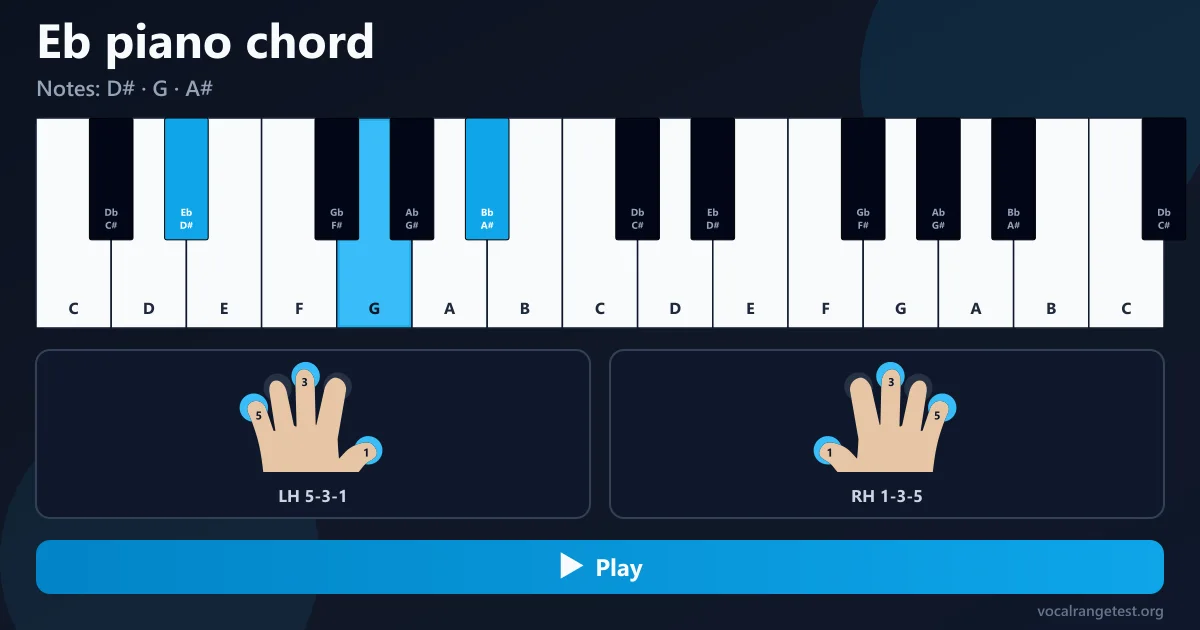
Notes: D# · G · A#
Voicing: 1 / 6
Fingering
Left hand: 5-3-1
Right hand: 1-3-5
Root
Chord type
Root position & inversions
Alternate bass
Eb chord piano — black, white, black: E♭, G, and B♭ under one major roof
An Eb chord piano grip is three notes: E♭, G, and B♭. On the keyboard that reads as black–white–black — you settle into the flats, then plant G as the bright hinge. The same pitches can be spelled as a D# chord piano triad (D♯–F𝄪–A♯), but lead sheets almost always choose the flat spelling when the neighbourhood is B♭, A♭, or E♭ major. Players search both names because charts disagree on letters while the sound stays identical. This page stays on that one major triad so you can hear the colour, own the two black keys, and move the bass through the inversions flat-key charts actually print.
When songs lean into Eb (and why D♯ shows up in searches)
In E♭ major, the triad is home — i. Brass bands, gospel choir rooms, and jazz standards love keys with flats because the horns sit comfortably there; an E flat major chord piano shape is the landing pad those rooms hear all night. In B♭ major, Eb is the IV: a warm plateau before the harmony turns. In A♭ major it often functions as V (or thickens later into Eb7). You’ll also meet it as a borrowed major colour when a ballad in C or G needs a sudden velvet lift. Emotionally Eb tends to read as warm velvet, slightly duskier than C or G, more “brass and choir loft” than parade-ground white-key major — major still, just with gravity from the flats.
Enharmonic spelling is the theory trap. E♭ and D♯ are the same key on the piano; the triad’s sound does not change when you rename it. What changes is the paper: flat-key charts write Eb, G, Bb; sharp-side theory drills sometimes write D♯ major and pile on double sharps that fight the hand. For most repertoire, learn the flat names first, then recognise that a search for D# chord piano is asking for this same grip. Real charts rarely freeze you in root position. Walking bass asks for Eb/G when the third is underneath and Eb/Bb when the fifth is the floor. Slash marks like Eb/D or Eb/C appear when the bass keeps moving under a held right-hand colour. Hearing the stacked triad and the broken pattern here turns those marks into sounds you can approve before your fingers copy them.
Two black keys you have to mean
E♭ and B♭ are not decoration. If either drifts toward a white neighbour, the triad stops reading as Eb. The diagram keeps both flats lit so you can judge the black–white–black spacing before you stretch.
Hear the major third before you rush the shape
Chord playback stacks E♭–G–B♭ so the major colour is unmistakable. Arpeggio mode walks the same tones so each lit key matches a pitch — useful while a tired finger still wants an all-white major from muscle memory.
Bass moves; the label still reads Eb
Root position is home. The same tools surface inversions and alternate bass so the harmony still functions as Eb when the lowest note is G, B♭, or something outside the triad — exactly what flat-key lead sheets throw at you first.
Eb in piano practice — listen online, break the triad open, move the bass
A still image of two black keys and one white cannot tell you whether G is truly speaking as the major third. Here the diagram stays tied to piano samples, left- and right-hand fingering, inversions, and the alternate-bass shapes flat-key charts print — so rehearsal time goes into hearing and placement instead of guessing from a silent picture.

Hear the triad, then split it into an arpeggio
Tap once for a solid Eb when you want the full velvet ring. Switch to arpeggio when you need to isolate whether G is carrying the major colour, or whether a soft finger has thickened a flat and muddied the stack toward something minor-ish. Playback follows the voicing you selected, so an inversion or slash shape sounds like the notes on screen rather than a generic root-position loop. That listen-and-compare habit is how a three-note flat-key picture becomes a chord you trust under a vocal, a horn section, or a choir pad.
- Click-to-hear chord or arpeggio on real piano samples
- Left- and right-hand fingering that updates with the voicing
- Root position plus Eb/G and Eb/Bb inversions
- Alternate-bass shapes such as Eb/D, Eb/C, and Eb/Db
- Same sound whether you searched Eb or D♯ — diagram first, spelling second
How to play Eb chord piano

1. Plant E♭ and B♭ first, then drop G in the middle
Start near middle C if the stretch feels natural; smaller hands can drop an octave without changing the chord’s identity. Find the two black keys that frame the triad — E♭ as the root, B♭ as the fifth — then seat G on the white key between them as the major third. A compact right hand often uses 1–3–5; the left commonly mirrors 5–3–1. If the chord suddenly sounds minor or muddy, check that G did not drift and that you did not land on E natural by accident.

2. Balance three even attacks so the flats speak without thudding
Eb lives on whether the black keys speak cleanly. Aim for three even attacks with no neighbouring whites ghosting under soft fingertips. The major third should brighten the stack, not hide under heavy flats. When the shape feels stable, trigger chord mode and compare your blend to the reference — especially whether G sits inside the velvet colour rather than poking out or vanishing.

3. Break it into an arpeggio until the black–white–black path feels automatic
Arpeggio mode lights each key as the pitch climbs. Watching E♭, then G, then B♭ fire in order is one of the fastest ways to lock the triad into muscle memory — and to separate it from all-white majors your hand prefers by habit. If one finger arrives late, slow down until your broken chord matches the page. This is where Eb in piano practice starts to feel musical: you hear the flats as part of a major colour, not as obstacles.

4. Move into Eb/G and Eb/Bb when the bass line needs to walk
Use the voicing controls for the inversions. Eb/G puts G underneath — common when a bass rises through the third or when a chart wants a lighter middle. Eb/Bb parks B♭ in the bass for an open floor that still reads as Eb. Listen in both chord and arpeggio modes so the new lowest note is obvious before you copy the hand. If a chart spells the fifth as A♯ in a sharp context, it is the same pitch you are hearing as B♭ here.

5. Preview alternate bass when the chart writes a slash you have not practised
Lead sheets sometimes keep an Eb colour in the right hand while the bass walks outside the strict inversion set — shapes like Eb/D, Eb/C, or Eb/Db. Preview those slash options above the fold until your ear owns the new floor note. Same triad tones up top, different gravity underneath — that mismatch is why slash chords confuse players who only drilled root position in white-key keys.
6. Put Eb in a key so the velvet has somewhere to go
For key of Eb chords piano study, start where flat-key charts lean hardest: as I in E♭ major, as IV in B♭, or as V (often thickening toward Eb7) in A♭. Hang on the triad, then walk a short line into a neighbour — Ab, Bb, or Cm — so your ear hears why writers pick this major colour instead of a brighter white-key home. Context beats isolated drilling; come back to this page whenever you want the large diagram, the inversion set, and the listen-and-break-apart tools again.