
E6 chord
Root position: The most common shape: the lowest note is the root named in the chord, with the other chord tones stacked above it.
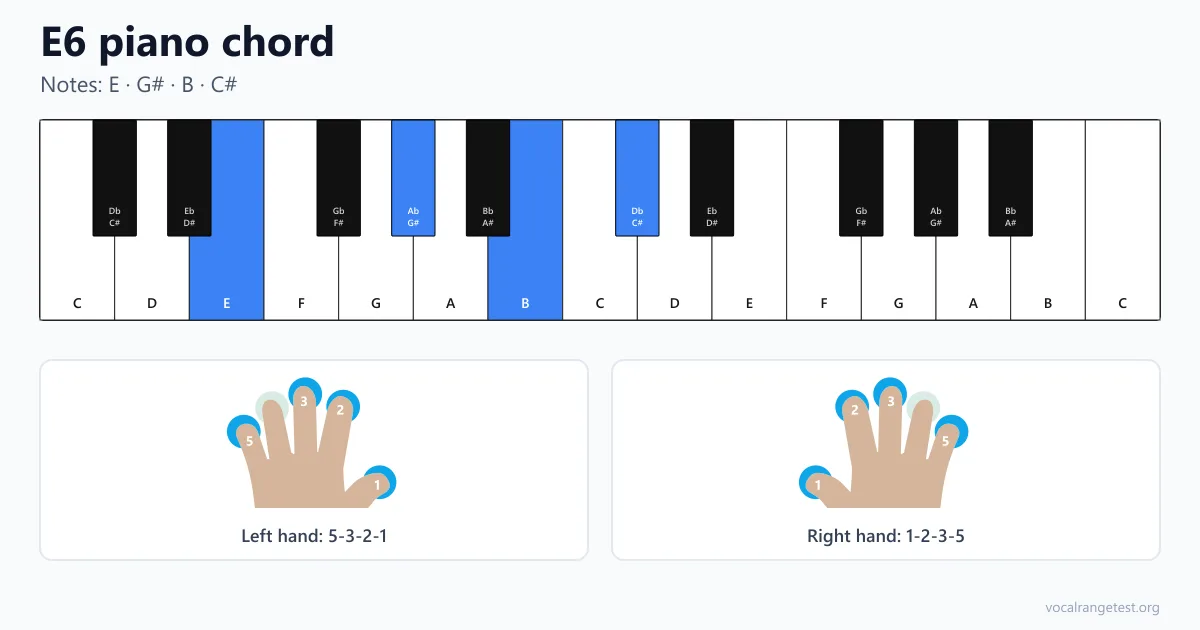
Notes: E · G# · B · C#
Voicing: 1 / 4
Fingering
Left hand: 5-3-2-1
Right hand: 1-2-3-5
Root
Chord type
Root position & inversions
E6 piano chord for players who already know open E on guitar—and need the keyboard version that still rings
An E6 piano chord is E major plus one more tone: C#. Spell it E–G#–B–C#. Plain E (E–G#–B) can feel like a bright stamp. Drop C# on top and the stamp softens—still major, just less final. Guitarists live in E because of the open strings; piano parts in those songs often want the same “ring” without a thick closed triad. If you searched for an E6 chord on piano you can hear before you memorize, use the keyboard above, then treat the notes below as coaching.
Two sharps you cannot shrug off
E major already asks for G#. E6 keeps that raised third and adds C#, the major sixth above E (a whole step above B). Miss G# and the chord tips toward minor or just sounds wrong. Miss C# and you are back to plain E—fine, but no longer E6. Players who rush white-key habits often flatten one sharp under tempo. Slow the arpeggio on this page: E, then G#, then B, then C#, until your ear expects both accidentals every time.
In real charts, E6 shows up when a songwriter wants E-major warmth that still leaves air under a sustained vocal—think pop ballads in E, countryish grooves, and worship-adjacent keys that sit well for many singers. You will also meet it as a colorful I chord in E, or as a bright IV flavor when the song centers on B. Theory jargon is optional: when you change inversions, listen whether the bass still feels like home (E) or like it is leaning toward G#, B, or C#.
C# is the personality
Without C# you have ordinary E. With C#, the major color stays, but the landing gets gentler—useful under long melody notes.
G# first, sixth second
If the chord sounds sad or muddy, check the third before you blame the sixth. A flat G# breaks the major family faster than a missing C#.
Cousins with C#m7
E–G#–B–C# share pitch classes with C#m7. Bass on E tells an E6 story. Bass on C# tips the ear toward C-sharp minor seventh. Flip those bottoms here and hear the difference.
How to play E6 chord on piano
Skip the silent PDF: audition the voicing, see every tone, then move the bass through the slash chords your left hand will actually meet.

Audition, peel apart, then shift the bass
Most charts stop at dots. Here you can fire E6 as one hit or walk E–G#–B–C# so each interval is obvious—especially the two sharps. Fingerings for both hands sit beside the shape, and the inversion set covers root position plus E6/G#, E6/B, and E6/C#. That loop (hear → break down → change bass) is the practical advantage of this page: ear and hands learn together in the browser, with nothing to install.
- Full-chord or note-by-note arpeggio preview
- Keyboard breakdown that lights each tone
- Root position and slash-bass inversions included
- Works free in the browser—no account wall
A practice path that respects the sharps

Lock E–G#–B before you touch C#
Right hand: thumb on E, then G# and B (try 1–2–3). Confirm it sounds major—bright, not minor—before adding the sixth. If four notes feel crowded, left hand can hold a low E alone at first.

Park C# so it reads against B
Add C# above B (a common four-note grip is 1–2–3–5 with 5 on C#). If B and C# smear into one thick cluster, roll the chord slightly or thin the middle. The sixth should announce itself as color, not mud.

Use inversions the way charts write them
E6/G# is the familiar “moving bass under a held E color” move—guitar slash charts love it. E6/B puts the fifth underneath for a wider base. E6/C# borrows the C#m7 bass story. Cycle them until you can name the bottom note without reading the label.

Place the voicing around the singer
Low vocals? Shift the right-hand cluster up an octave so you are not fighting the melody. Sparse arrangements often sound cleaner with low E in the left hand and a compact E6 in the right than with two full walls of keys.