
D6 chord
Root position: The most common shape: the lowest note is the root named in the chord, with the other chord tones stacked above it.
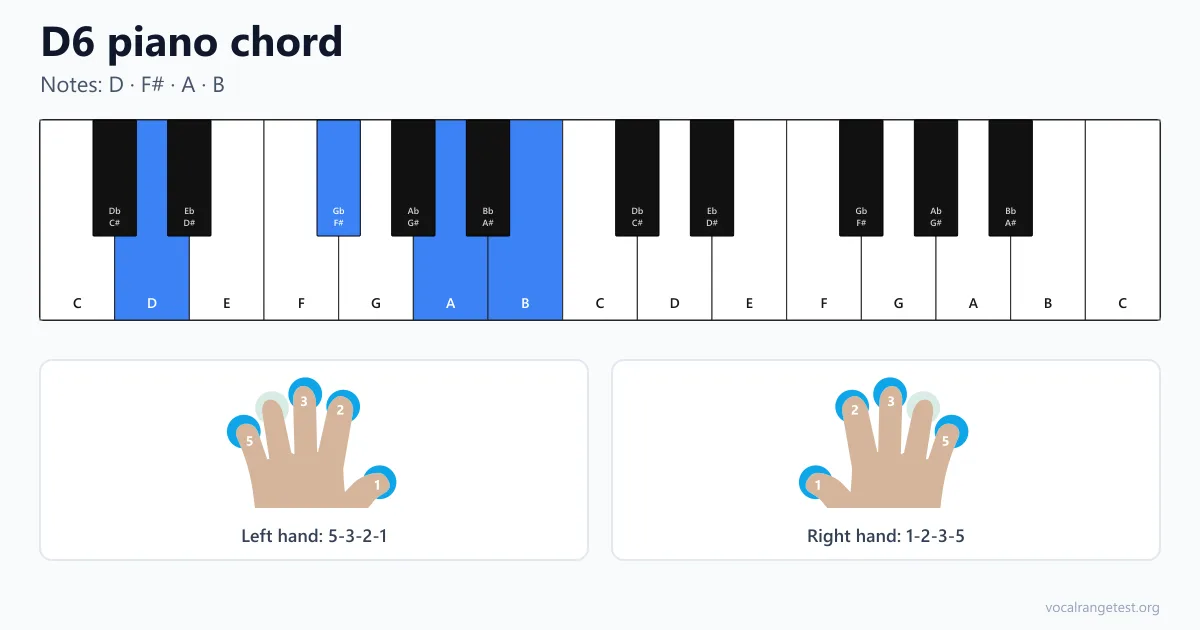
Notes: D · F# · A · B
Voicing: 1 / 4
Fingering
Left hand: 5-3-2-1
Right hand: 1-2-3-5
Root
Chord type
Root position & inversions
D6 piano chord guide for players who want the sound before they memorize the shape
D6 is D major with one extra tone: B. Written out, that is D–F#–A–B. The triad alone (D–F#–A) can feel like a firm handshake. Drop B on top and the grip loosens—still major, just less final. Folk, country, soft rock, and a lot of singer-songwriter charts lean on this color when a bare D sits too hard under a vocal. If you typed “D6 piano chord” looking for something you can hear and finger—not a PDF of silent dots—start with the interactive keyboard above, then use the notes below as coaching, not homework.
The F# is not optional decoration
D major needs F#, the black key between F and G. Skip it and you have accidentally built a D minor–ish mess or a weird suspended sound, depending on what else you grab. In D6 that F# still does the major-third job; B is the newcomer, a major sixth above D (or a whole step above A). On white-key-heavy habits, players sometimes flatten F# by accident when they rush. Slow the chord down with the arpeggio playback on this page until your ear expects that raised third every time.
Another practical angle: D is a home key for countless guitar-friendly songs, so piano parts in those charts often want a D that blends with open-string guitar voicings. A D6 chord on piano mirrors that “ringy” quality better than a thick closed triad. You will also meet D6 as a colorful I chord in D major, or as a bright IV color when the song is centered on A. None of that requires theory class—just notice whether the bass feels like home (D) or like it is leaning somewhere else when you change inversions.
B changes the landing
Without B you get plain D. With B, the chord stops short of slamming the door shut. That is why ballads and mid-tempo verses love it under long notes.
Watch the black key
F# is the difference between “D major family” and “something went wrong.” If the chord sounds sad or muddy, check that third before you blame the sixth.
Same letters as Bm7, different floor
B–D–F#–A are the pitch classes behind both Bm7 and D6. Bass on D says “we are in D6 land.” Bass on B tips the ear toward B minor seventh. Compare those bottoms on this page.
How to play D6 chord on piano
Skip the guesswork: hear the voicing, see every note, then move through the positions your left hand will actually need.

Sound, split tones, then move the bass
Most static diagrams stop at a picture. Here you can trigger D6 as one hit or walk D–F#–A–B so each interval is obvious. Fingerings for both hands sit beside the shape, and the inversion carousel covers root position plus D6/F#, D6/A, and D6/B. That is the real practice loop—listen, check the breakdown, change the bass—without installing an app or creating an account.
- One-click chord tone or arpeggio preview
- Note-by-note breakdown on the keyboard
- Root position and slash-bass inversions included
- Works in the browser; nothing to install
A simple path from first shape to usable voicings

Plant D, then add F# and A
Right hand: thumb on D, then F# and A (try 1–2–3). Confirm it sounds major—bright, not minor—before you touch B. Left hand can take a low D alone if four notes feel crowded at first.

Slot B on top without crushing A
Add B above A (right-hand 5 on B is common in a four-note grip: 1–2–3–5). If B and A blur into one thick clump, roll the chord slightly or thin the middle. The sixth should read as a clear extra color, not mud.

Move the bass for real-song motion
D6/F# is the classic “moving bass under a held D color” move—guitar charts write it constantly. D6/A puts the fifth underneath for a wider foundation. D6/B borrows the Bm7 bass story. Cycle them here until your ear tags the bottom note without peeking at the label.

Match the register to the singer
If vocals sit low, shove the right-hand cluster up an octave so you are not fighting the melody. If the arrangement is sparse, a low D in the left hand plus a compact D6 in the right often beats a giant two-handed wall of sound.