
B6 chord
Root position: The most common shape: the lowest note is the root named in the chord, with the other chord tones stacked above it.
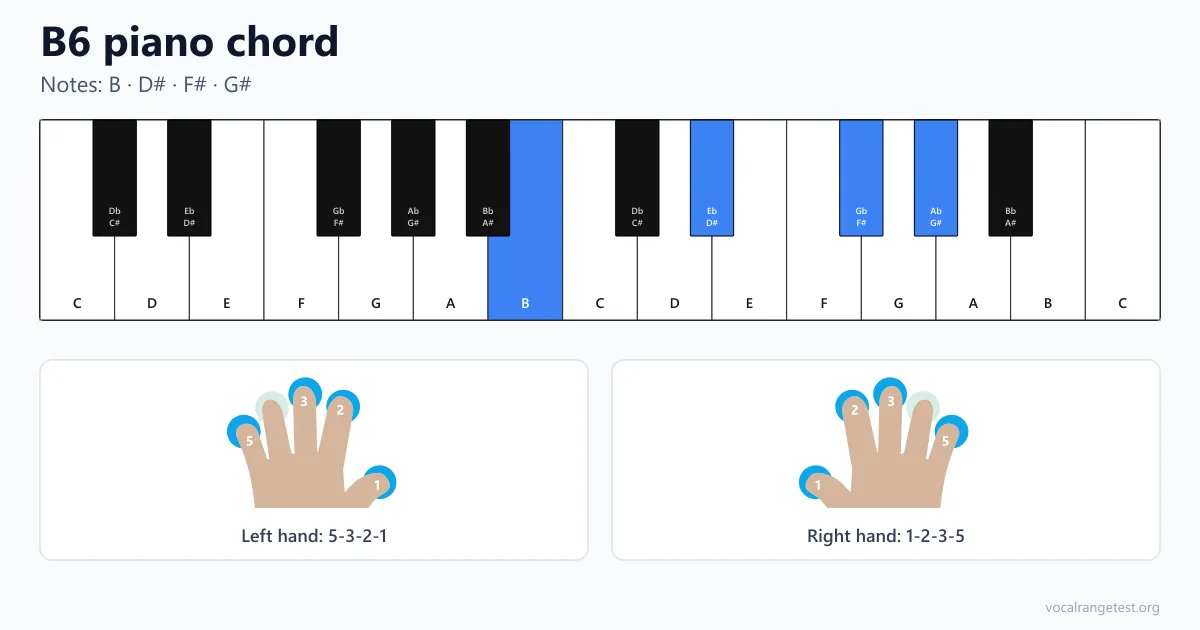
Notes: B · D# · F# · G#
Voicing: 1 / 4
Fingering
Left hand: 5-3-2-1
Right hand: 1-2-3-5
Root
Chord type
Root position & inversions
B6 piano chord when B major needs sparkle but not a clenched fist
A B6 piano chord is a B major triad with G♯ riding as the sixth: B–D♯–F♯–G♯. That stack leans hard on black keys, so beginners often meet B as “the scary major” long before they meet a friendly white-key sixth. Plain B can sound bright and a little stiff under a vocal—powerful, yes, but crowded if both hands mash the triad. Bmaj7 adds A♯ and tips the harmony toward jazz polish. B6 keeps the major frame and adds the major sixth (G♯), so you still get that lifted B color with a softer landing. If you searched “b6 piano chord” or “b6 chord on piano” because you want to hear the difference—not stare at a silent diagram—start with the keyboard above and let B, D♯, F♯, and G♯ speak before you memorize a grip.
Where B6 actually shows up—and why the sharps matter
Songs in B major (or with a strong B harmony) often come from guitar-friendly writing, bright pop hooks, or arrangements that want a high, ringing major center. On piano, that same key can feel dense: D♯ and F♯ already pull the hand onto black keys, and a thick triad in both hands fights the singer. Writers reach for B6 when they want major lift that still leaves air—think choruses that glow rather than punch, pads under a sustained note, or a piano part that needs to match open-string energy without copying a guitar wall. You will also see B6 as I in B, as a warmer IV when the song lives in F♯, or as a color after F♯ or before E in progressions that circle those sharps. In plain talk: if the chart wants “happy but not boxed shut,” and the root is B, the sixth is a practical paintbrush.
Quick theory without the fog: G♯ is a whole step above F♯, the fifth of the triad. That whole step is the “6” in the label. Ear check: B–D♯–F♯–G♯ are the same pitch classes as G♯m7. Bass on B tells a B6 story; bass on G♯ leans toward G♯ minor seventh. Flip those bottoms with the inversion controls—B6, B6/D♯, B6/F♯, B6/G♯—and the slash marks on a lead sheet stop feeling random. Also watch the spelling: B6 is not B♭6. One is rooted on B natural with D♯; the other lives a half step lower with a flat-heavy triad. Mixing them up is a common lead-sheet stumble when someone scribbles “B6” after playing in flats all night.
G♯ is the softener in a sharp-heavy chord
Without G♯ you have ordinary B. With G♯, the major color stays, but the phrase does not lock as hard—useful under long melody notes in a bright key.
D♯ makes it major—no shortcuts
B major needs the raised third. If the voicing sounds gloomy or “almost right,” check D♯ before you fuss with the sixth. A natural D turns the family minor in one wrong finger.
Neighbors: Bmaj7 and G♯m7
Bmaj7 wants A♯, a half step under the next B. B6 wants G♯, a whole step above F♯. Same letter set as G♯m7, different bass story—learn both so charts do not swap your ear.
How to play B6 chord on piano
A flat diagram will not teach how those black keys color the harmony. Here you audition the chord, peel it into single tones, and walk the inversions your left hand meets in real arrangements.

Sound first, then the sharp map, then the bass
Trigger B6 as a full chord or as a broken arpeggio so B, D♯, F♯, and G♯ each get a clean turn—especially helpful when black keys want to blur. Left- and right-hand fingering guides sit beside the keys. Move through root position plus B6/D♯, B6/F♯, and B6/G♯ without leaving the page. Live piano sound, note-by-note breakdown, and voiced positions are the point of this tool: ear and hands learn the same shape in the browser, free, with no signup. Printed chord sheets rarely give you that loop.
- Play B6 as a chord stack or note-by-note arpeggio
- See which keys light and which fingers cover them
- Compare inversions B6, B6/D#, B6/F#, B6/G# by the bass
- Browser-based—no app install, no account wall
Map the black keys, then make the sixth count

Lock B–D♯–F♯ before you invite G♯
Right hand: find B, then D♯ and F♯ (a common start is 1 on B, 2 on D♯, 3 on F♯). Confirm a bright B major triad—major, not minor—before adding anything. If four notes feel cramped, let the left hand hold a low B alone while the right works the upper cluster.

Add G♯ so the label matches what you hear
Place G♯ above F♯ (often 1–2–3–5 with 5 on G♯). Play B–D♯–F♯, then add G♯, and listen for the color change—that whole step above the fifth is why the chord is called a sixth. If G♯ vanishes under a heavy F♯, thin the fifth or lift the whole voicing an octave.

Practice the slash basses charts print in sharp keys
B6/D♯ puts the third underneath—smooth for stepwise left-hand motion when writers want B color without a heavy root. B6/F♯ lays the fifth on the floor for a wider base. B6/G♯ borrows the G♯m7 bass flavor when a chart wants major harmony with a minor-ish bottom. Cycle them here until you can name the lowest note without peeking at the label.

Stay out of the singer’s lane
High, bright melodies are common in B. If the vocal sits up top, keep your right-hand cluster from doubling every pitch. A low B in the left hand and a compact B6 in the right often clears more space than two dense sharp-key walls.