
C#6/Db6 chord
Root position: The most common shape: the lowest note is the root named in the chord, with the other chord tones stacked above it.
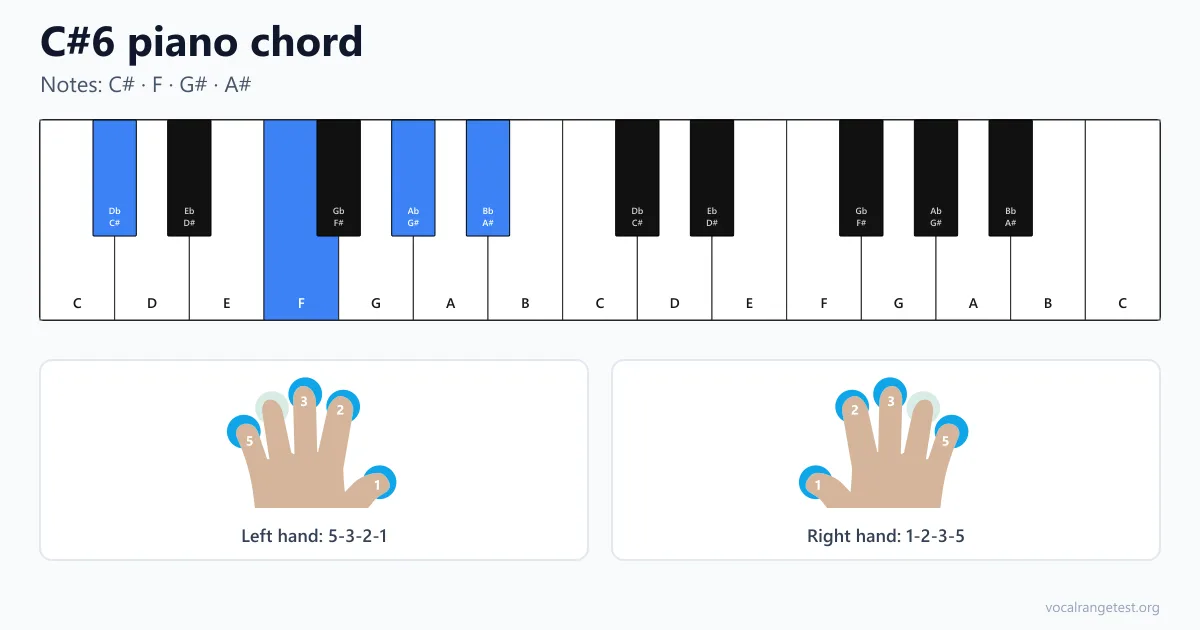
Notes: C# · F · G# · A#
Voicing: 1 / 4
Fingering
Left hand: 5-3-2-1
Right hand: 1-2-3-5
Root
Chord type
Root position & inversions
C#6 piano chord — the soft major colour flat-key charts often print as Db6
A C#6 piano chord is a C-sharp major triad with a major sixth parked on top. In note names that stack is C#, F, G#, and A# — F standing in for the E# sharp-key theory wants, A# supplying the sixth that turns a plain triad into something warmer and a little old-fashioned in the best way. Search boxes and lead sheets also call this a c sharp 6 piano chord or a Db6 piano chord; Db6 is just the flat spelling of the same four keys (Db, F, Ab, Bb). The sixth sits a whole step under the root’s octave, so the colour feels settled rather than tense. This page is built so you can hear real piano samples, break the grip into an arpeggio, check fingerings, and walk through inversions before you trust the shape in a song.
When a Db6 piano chord (or C#6) shows up — and what it usually feels like
Writers reach for this colour when a straight major triad feels too bare but a major seventh would float too much. In Db major, a d flat 6 chord piano symbol often marks home base with a gentle smile — I6 instead of plain I — the kind of tonic you hear under vintage ballads, country bridges, and quiet Christmas arrangements. Sharp-side charts living in C# or F# keep the ink as C#6 so the accidentals stay consistent. Emotionally it reads warm, nostalgic, and slightly crooner-ish: major brightness without the half-step rub that makes maj7 shimmer. Hold a plain C# or Db triad next to it and the triad sounds blunt; add the sixth and the chord gains a soft glow. Hold C#maj7 beside it and you hear the other job — maj7 hovers; the sixth sits down and makes itself comfortable.
Recipe in plain language: major triad plus a major sixth above the root. Miss the sixth and you are back to three notes. Swap the sixth for a minor seventh and you have flipped into dominant-seventh grit — a common mix-up when someone reads “6” as “add a seventh somehow.” One useful ear trick: the same four pitches also spell A#m7 / Bbm7. That does not mean every C#6 is “really” a minor seventh chord; it means jazz players sometimes re-label the stack when the bass note changes. For day-to-day pop reading, trust the chart: if it says C#6 or Db6, treat the written root as the floor of the harmony. Inversions still matter early. Compact left hands ask for C#6/F, C#6/G#, and C#6/A# — same sixth colour, different lowest note. Hearing the stacked chord and the broken arpeggio here turns those slash marks into sounds you can approve before the fingers copy them.
The sixth is a whole-step story
A# against C# (or Bb against Db) sits a whole step under the octave. That gap is why sixth chords feel warm and settled instead of tense or floaty.
Db6 and C#6 are paperwork twins
Flat-key songbooks prefer Db6; sharp-key rehearsal charts often keep C#6. Your hands press the same four keys either way — match the spelling to the rest of the bar.
Practice with sound, not a mute diagram
This site lets you hear real piano samples as a full chord or an arpeggio, shows left- and right-hand fingerings, and unlocks inversions plus alternate bass so you judge colour and stretch by ear.
Hear the C#6 chord on piano with breakdown, fingerings, and inversions
Mute screenshots hide whether the sixth is sweet or muddy in your register. Here you preview stacked sound, split the tones, lock fingerings, then move through inversions and alternate bass on the same free page.

Lock the warm stack, then isolate the sixth
Start with the full C#6 grip so your ear learns the colour as one object. Switch to arpeggio mode when you need to confirm each pitch — especially the A# (or Bb in Db6 spelling) that separates this chord from a plain major triad. Left- and right-hand fingerings update as you change voicing, so the stretch you hear is the stretch you will practice.
- Hear stacked chord or rising arpeggio on real piano samples
- Left- and right-hand fingerings update with each voicing
- Root position plus C#6/F, C#6/G#, and C#6/A#
- Alternate bass when a chart writes a slash outside the basic set
- Same sixth sound whether the sheet says C#6 or Db6
How to play C#6 chord on piano

1. Build the major triad, then place the sixth on purpose
Find C#, F, and G# first — that is your major triad (F covering the E# spelling). Add A# above or beside the triad so the sixth has a clear seat. If you learned the flat names, build Db, F, Ab, then Bb. Play the four tones together once, then alone, until the sixth feels chosen rather than accidental.

2. Keep the sixth warm instead of crowded
In close position the sixth can sit right next to the fifth. Soften the top note slightly if the grip feels thick in the midrange, or drop the sixth into a wider spacing so air opens between G# and A#. The goal is a gentle major glow, not a cluster that fights the melody.

3. Arpeggiate until both spellings feel automatic
Use the page’s arpeggio mode to roll C#–F–G#–A# slowly, then at song tempo. Flip the mental labels to Db–F–Ab–Bb without moving your fingers. When either spelling reads cleanly, you stop hesitating mid-chart when a writer switches ink from sharps to flats.

4. Move into C#6/F, C#6/G#, and C#6/A#
Root position is only the starting photo. First inversion (F in the bass) smooths many left-hand connections; second inversion (G#) often supports a pedal fifth; third inversion (A# bass) puts the colourful sixth underneath, which can sound like a soft minor-seventh flavour until the upper voices clarify the C# root. Audition each inversion here before you commit muscle memory.

5. Preview alternate bass when the arrangement wanders
Some charts keep a C#6 symbol above the staff while the bass walks to a note outside the basic inversion set. Use alternate-bass listening to check whether that slash still supports the sixth colour or whether you should thin the right hand. Approving the sound first saves you from learning a stretch that fights the arrangement.
6. Drop the chord into a key so the colour has a job
In Db major, treat Db6 as a softer tonic. In Ab major the same pitches can colour IV with a country or gospel lift. In F# major, C#6 often acts as a gentle V-area colour or a passing tonicisation depending on the bass. Play a short I–vi–IV–V loop and swap plain majors for sixths on the I or IV — you will hear why arrangers reach for this sound when they want warmth without drama.