
Bsus chord
Root position: The most common shape: the lowest note is the root named in the chord, with the other chord tones stacked above it.
Notes: B · E · F#
Voicing: 1 / 6
Fingering
Left hand: 5-2-1
Right hand: 1-4-5
Root
Chord type
Bsus4
Bsus2
B Sus Chord Piano Without the Theory Fog
A B sus chord piano grip is easier than the symbol looks. You keep B and F♯ as the outer posts, then park a temporary middle note: E for Bsus4, or C♯ for Bsus2. That middle note is why the chord feels unfinished—and why songwriters use it on purpose.
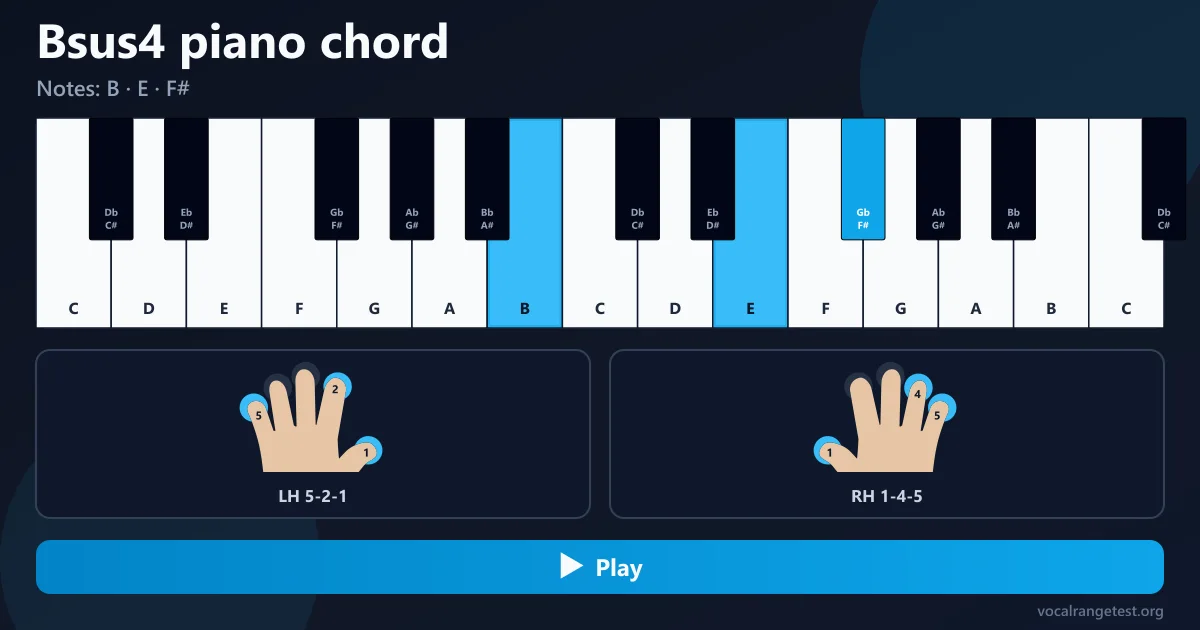
What hangs, and what finally lands
Plain B major is B–D♯–F♯. That D♯ is the bright major third; it tells your ear “we’re home in major.” Strip D♯ out and drop E in its place and you get the everyday B sus 4 piano chord: B–E–F♯. Swap in C♯ instead and you get the softer B sus 2 piano chord: B–C♯–F♯. Same frame, different filler. Neither spelling picks major or minor for you—the chord sits on the fence until you resolve it.
People who search B sus chord on piano are rarely hunting a museum piece. They usually already live near B: guitarists who capo into B shapes, worship loops that hang on B before a chorus, rock intros that refuse to finish the cadence, or singer-songwriter verses that want tension without switching to a full minor color. You do not need Roman numerals first. Listen to how E pulls toward D♯ (into B major), and how C♯ feels like a quieter neighbor before you choose which story fits the lyric.
Bsus / Bsus4 — what most charts mean
When a lead sheet writes bare Bsus, it almost always means B–E–F♯. Players and teachers treat Bsus and Bsus4 as the same everyday hang. Open the Bsus4 group on this page if that is the spelling you saw.
Bsus2 — same outer posts, calmer middle
B–C♯–F♯ keeps B and F♯ but replaces the fourth with a second. It often feels wider and less “church cadence” than sus4. Charts that want this color usually write the 2 on purpose.
Why B shows up so often in bands
B sits next to open-string guitar keys like E and F♯. A B sus chord piano voicing lets a keyboardist match a guitar hang without sounding like a stiff textbook triad. That is practical stage vocabulary, not trivia.
What Is B Sus Chord Piano, in Plain Words
Think of two fence posts—B low, F♯ high—and one temporary board in the middle. Change that board and the mood changes. Keep the posts and the chord still belongs to the B family. That is the whole idea, without a lecture on modes.

Hear the hang before you memorize dots
Printed charts show where fingers go. They cannot prove the unfinished sound. On this page you click a B sus chord on piano samples, switch between the full block and a rising arpeggio, and judge whether E or C♯ is doing the emotional work before you copy a grip into a song.
- Separate Bsus4 and Bsus2 groups so you compare the hang instead of guessing one abbreviation.
- Block chord or arpeggio playback on real piano samples—not a mute poster.
- Left- and right-hand fingerings that update as you change voicing.
- Inversions and alternate-bass shapes when a left hand needs a different floor under a long B section.
- Free in the browser: no install, no account wall to audition a single color.
How to Lock a B Sus Chord on Piano in Three Short Passes

1) Plant the outer posts first
Find B, then F♯ above it. If those two notes are wrong, no middle tone will sound like a B-family hang. Both Bsus4 and Bsus2 share this frame—locking it early prevents half the confusion.

2) Choose the middle board, then hear it resolve
For the common B sus 4 piano chord, place E between B and F♯. Play the block, then arpeggiate so each lit key matches a tone you hear. Switch to the B sus 2 piano chord group (B–C♯–F♯) and resolve both shapes into plain B major. Notice which drop feels cleaner (often sus4→B) and which feels softer (often sus2).

3) Move the bass only after the hang makes sense
Once the color is clear in root position, step through inversions or alternate bass on the same diagram. Keep listening in block and arpeggio so the new lowest note is obvious before you trust the fingering. That loop—hear, break down, then move bass—is what turns a symbol into something you can actually use in a rehearsal.