
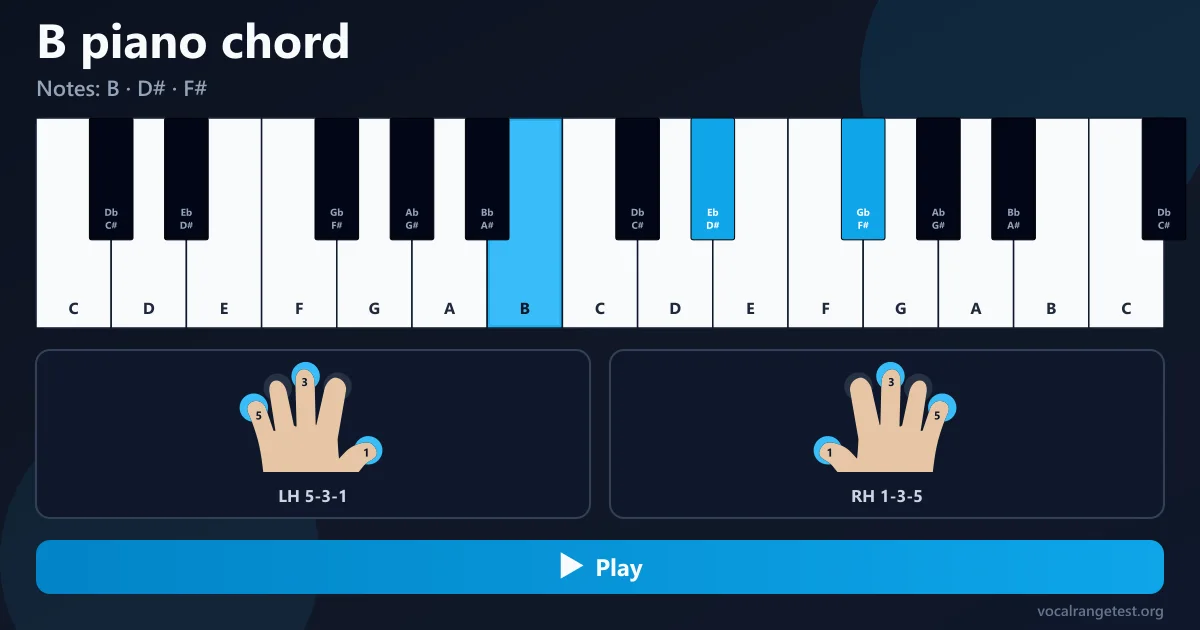
B chord
Root position: The most common shape: the lowest note is the root named in the chord, with the other chord tones stacked above it.
Notes: B · D# · F#
Voicing: 1 / 6
Fingering
Left hand: 5-3-1
Right hand: 1-3-5
Root
Chord type
Root position & inversions
Alternate bass
B major on piano: confident color, black-key control, and smoother progressions than most beginners expect
The b major chord piano shape looks simple on paper and surprisingly revealing under your fingers. The notes are B-D#-F#, so this triad lives partly on black keys and immediately exposes hand alignment, finger angle, and touch consistency. That is exactly why players search for b major in piano after they have learned a few white-key chords: they can name the notes, but they still want the chord to sound clean and musical at tempo. This page is built for that moment. Instead of a static keyboard picture, you can hear the full chord online, switch to arpeggio to break the harmony into single tones, test inversions, and compare slash-bass choices in one place. In other words, you are not just memorizing a symbol; you are training how B major behaves inside real songs.
Where B major shows up, and why its mood works
B major often carries a polished, modern brightness. It can feel triumphant without being harsh, and spacious without becoming vague. In full-band arrangements, B major is common when producers want a lifted chorus color that still supports strong lead vocals. In worship and contemporary pop, it appears frequently because it supports smooth melodic lines and clean transitions to related harmonies like E major, F# major, and G#m. In functional terms, B major can serve as I in the key of B, IV in F#, or V in E major, so it participates in both stable and forward-driving harmonic roles. The practical takeaway: this chord is not niche theory trivia. It is a working chord for songs that need clarity, energy, and controlled emotional lift.
Search behavior tells the same story. Someone typing key of b chords piano usually wants two things: a reliable B major sound under the hands and better decision-making inside progressions. That is why this page emphasizes hearing and comparison. Block playback helps you judge tone weight and blend. Arpeggio playback helps you confirm whether each pitch speaks evenly, especially D#, which defines major quality more than most learners notice. Then you can move into slash vocabulary, where b/d# chord piano and b/f# chord piano become useful arrangement choices rather than scary symbols. B/D# often smooths a rising or connecting bass line; B/F# often reinforces drive and width, especially before motion toward E or G#m. Once your ear hears those differences, your voicing choices become musical choices, not random experiments.
Online hearing makes black-key accuracy practical
You can test your voicing immediately instead of guessing from a diagram. That matters on B major, where small angle mistakes can blur clarity even when the right notes are technically pressed.
Chord breakdown reveals what your hand is hiding
Switching from full chord to arpeggio quickly exposes uneven touch and timing. If one tone jumps out or disappears, you hear it right away and can fix finger pressure before bad habits lock in.
Inversions and alternate bass live in the same workflow
Compare root position, inversions, and slash-bass options on one page. This is faster than hopping across separate lessons and helps you learn transitions by ear and feel together.
A b major chord piano page you can actually practice on
You get online audio, chord/arpeggio breakdown, fingering guidance, inversions, and alternate-bass shapes in one screen. The goal is not to name the chord once, but to play it cleanly in real musical contexts.

From symbol recognition to usable sound
Click once for the full B major sonority, then break it into arpeggio for detail work. Add inversion and slash comparisons to hear how the same harmonic identity shifts with bass placement and register focus.
- Click-to-hear piano audio in chord and arpeggio modes
- Left and right hand fingering diagrams tied to voicing
- Root position plus inversion comparison on-page
- Alternate bass options including B/D# and B/F#
- Fast A/B listening to refine tone, balance, and transition feel
How to play b chord piano with cleaner tone and control

1. Build the triad first: B-D#-F#
Place the notes quietly and check spacing before adding volume. B major is unforgiving if your wrist collapses toward black keys, so aim for stable finger pads and relaxed knuckles from the start.

2. Hear block chord, then arpeggio detail
Use full-chord playback to assess overall color, then arpeggio mode to inspect each tone. If D# is buried, the chord can sound less major and less alive than intended.

3. Choose fingering by function, not habit
One fingering can feel great in isolation and fail in progression work. Test fingerings against tempo and transition targets so your B major resets quickly when moving to E, F#, or G#m.

4. Compare inversions before slash bass
Inversions teach internal balance and voice-leading with the same three notes. Once those are reliable, add slash-bass forms to shape bass motion intentionally rather than by guesswork.

5. Use B/D# when you need a connected bass climb
B/D# can smooth movement between neighboring harmonies and reduce heavy jumps in the left hand. It keeps B-major identity while changing the line’s contour and emotional pull.
6. Use B/F# for weight, drive, and pre-resolution energy
B/F# often feels broader and more directional, especially before chords that resolve tension or open a chorus. Keep listening mode active so you choose the bass note by ear impact, not by label alone.