
Bdim chord
Root position: The most common shape: the lowest note is the root named in the chord, with the other chord tones stacked above it.
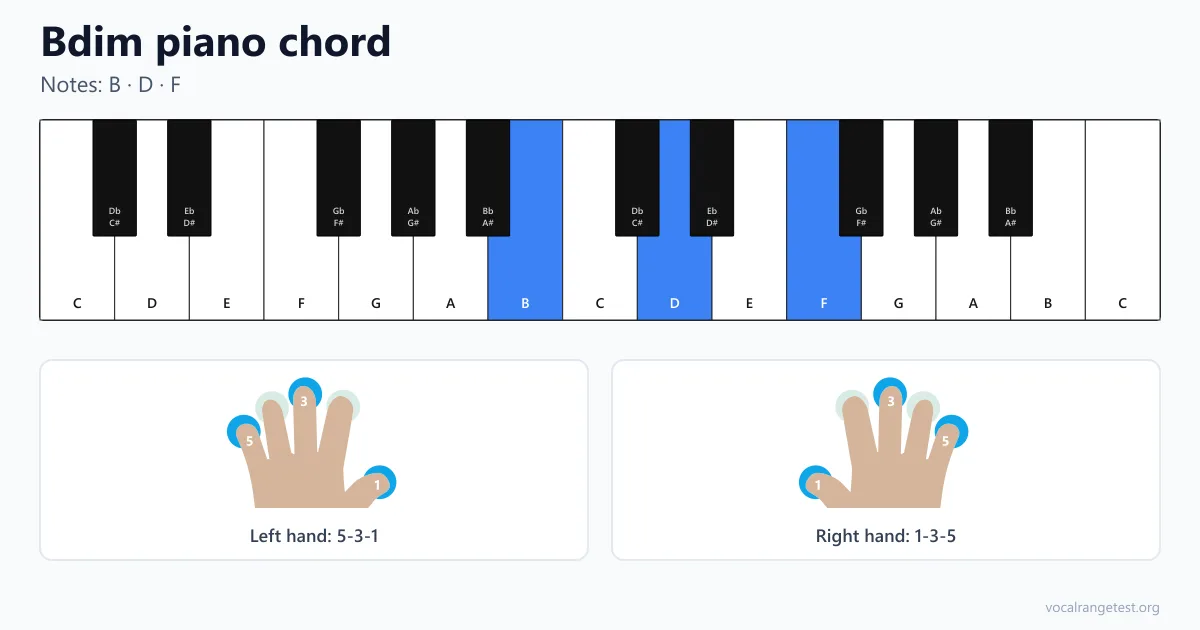
Notes: B · D · F
Voicing: 1 / 3
Fingering
Left hand: 5-3-1
Right hand: 1-3-5
Root
Chord type
Root position & inversions
Bdim piano chord: three notes that refuse to sit still
A Bdim piano chord is B, D, and F played together. That is a diminished triad: a minor third from B to D, then another minor third from D to F, which leaves a tense tritone between B and F. Charts may write Bdim, B°, or the longer name B diminished. Same three keys. On this page you can hear the chord as a block, split it into an arpeggio, read left- and right-hand fingerings, and move through the inversions without leaving the diagram.
Why Bdim shows up when a song needs a shove
Most major and minor triads feel like rooms you could stay in. Bdim does not. The flat fifth pulls the ear forward, so arrangers often use it as a short bridge rather than a place to land. In C major and A minor, Bdim is the leading-tone triad (vii°). Play B–D–F, then roll into C–E–G, and you will hear why theory books call that motion resolution: the restless chord empties into a stable one. Pop and film cues borrow the same trick when a scene needs a flicker of dread before the chorus or the cut.
You will also meet a Bdim chord on piano as a passing color between two stronger chords—say Am and C, or G and Am—where it lasts a beat or two and then disappears. Jazz players stack a seventh on top and talk about Bdim7; that is a different spelling and a different page. Here we stay with the three-note B diminished triad and its inversions, so you can learn the shape before you add extras.
Hear it before you memorize ink
Click the diagram to play the Bdim piano chord as a solid grip, then switch to arpeggio mode and walk B, D, and F one note at a time. Matching sound to keys beats staring at a static PDF.
Inversions change the bass, not the DNA
Root position is B in the bass. Bdim/D puts D underneath; Bdim/F puts F underneath. The pitch set stays B–D–F. Use the inversion controls when a bass line needs a smoother step into the next chord.
Fingerings for both hands
The page shows practical left- and right-hand finger numbers for each voicing, so you can check a grip before you take it to a real keyboard or a lesson.
What is Bdim chord piano?
Plain-language notes for players who want the sound, not a textbook chapter

The three notes, without the fog
B diminished chord piano spelling is B–D–F. Count the steps: B to D is three semitones (a minor third). D to F is another three. B to F is six semitones—the tritone that makes the chord feel unfinished. If a teacher writes B°, they still mean those same keys on the piano.
How to practice the Bdim chord on piano here

1. Plant the root-position shape
Find B near middle C, then D and F above it. Play the block once, listen, then run the arpeggio slowly until every lit key matches what you hear. If one note feels muddy, mute the others and isolate it.

2. Walk the inversions on purpose
Switch to Bdim/D, then Bdim/F. Keep the same three pitch classes; only the lowest note moves. Say the bass note out loud while you play—B, D, F—so slash chords on a lead sheet stop looking like new mystery shapes.

3. Resolve it so your ear learns the job
After any Bdim voicing, play a simple C major triad. Notice how the tension drops. That Bdim-to-C move is the everyday use case in C major and related keys. Repeat until the release feels obvious, then try resolving toward Am if you are working in A minor.