
B9 chord
Root position: The most common shape: the lowest note is the root named in the chord, with the other chord tones stacked above it.
Notes: B · D# · F# · A · C#
Voicing: 1 / 4
Root
Chord type
Root position & inversions
Two-hand voicing
B9 piano chord — five tones that keep the dominant bite and add a bright ninth
A B9 piano chord is five notes: B, D♯, F♯, A, and C♯. Think of it as a B7 stack with one extra pitch — the ninth, C♯ — sitting a whole step above the root. The first four tones still do the dominant job (major triad plus flat seventh). The C♯ is the colour most players came looking for when they typed the symbol. Without that ninth you are back in plain B7. With it the harmony stays restless toward E, but the top of the chord opens up and sounds a little more “sung,” which is why funk grooves, R&B pads, jazz comps, and soul charts reach for B9 instead of stopping at the seventh. This page is built around that one colour so you can hear the full grip, peel it into an arpeggio, check fingering for left or right hand, and move through the inversions and two-hand layouts that five-note chords actually need at the bench.
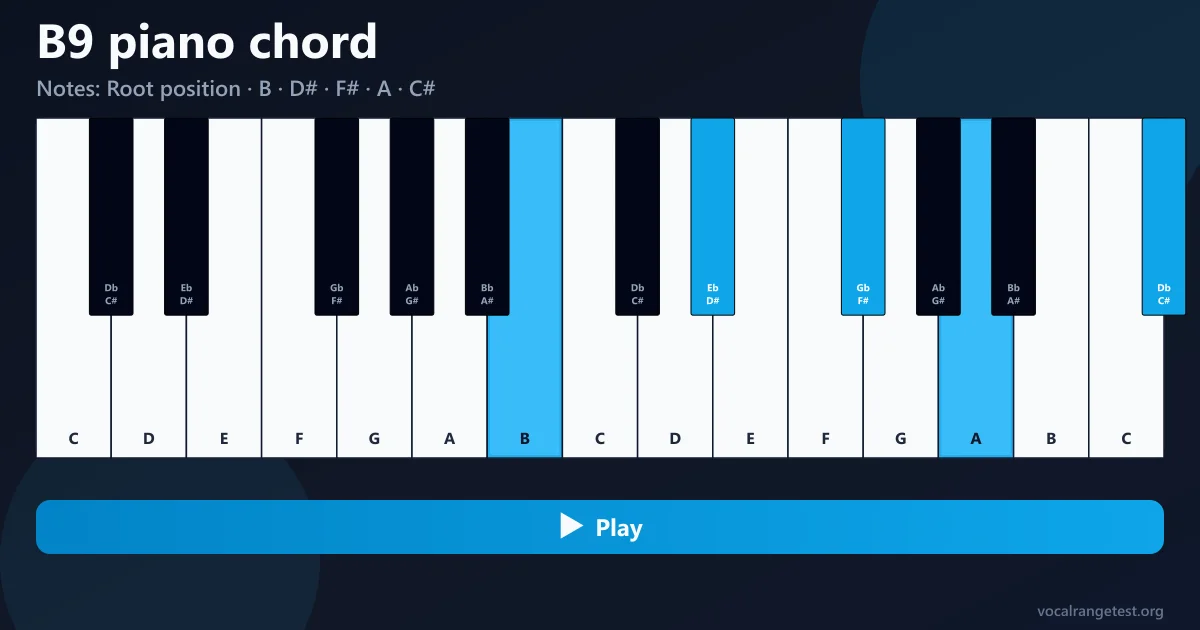
How to play B9 chord on piano
Root position spells B–D♯–F♯–A–C♯ from the bottom. On a real keyboard that means white, black, black, white, black — a mixed stretch that rarely sits under one hand the way a triad does. Many players start by planting B in the left hand and stacking the upper tones in the right, or by using the two-hand split on this page (left on B and F♯, right on A, C♯, and D♯). Press the whole chord once so your ear locks the colour, then switch to arpeggio and walk B, D♯, F♯, A, C♯ in order. The note that usually disappears when people rush is C♯ — they land a clean B7 and never add the ninth. If you can name that C♯ by ear, the symbol on the chart stops being a guess.
Charts will not keep you in root position forever. B9/A puts the flat seventh in the bass while the upper voices still spell the same chord — a smooth step when a bass line is walking and the harmony still needs to read as B9. Other bass moves show up in arrangements even when every chord tone is not printed under one hand. On this page you can flip those shapes, hear each one on piano samples, and match left- or right-hand fingering as the lowest note changes, so a slash mark in rehearsal is a sound you already know rather than a surprise.
C♯ is the difference between B7 and B9
B, D♯, F♯, and A already make B7. C♯ turns the label into B9. Hear the full stack, then arpeggiate until that ninth is as clear as the root. If the chord suddenly sounds “complete but smaller,” you probably dropped the C♯ without noticing.
Five notes ask for a plan, not a stretch contest
Crowding all five tones into one hand often hurts more than it helps. Dropping the fifth (F♯) in denser bands, or splitting the stack across both hands, is normal piano practice — not a shortcut. The interactive diagram lets you try root position, B9/A, and the two-hand layout so you pick a grip that still sounds like B9.
Hear it before you force the black-key shape
A mute poster cannot prove how C♯ sits on top of the B7 bite. Here you click full chord or arpeggio, flip fingering, and step through inversions on one diagram — practice time goes into ear and hand, not into decoding a silent grid.
Where a B9 chord on piano actually earns its keep
People searching this symbol usually want roles and neighbours, not a theory-exam lecture. Here is how B9 shows up in real music.

V9 colour in E — and a brighter home hit in B grooves
In E major or an E blues, B9 is the classic dominant doorway with extra air on top: still pulling toward E, but less blunt than a bare B7. In B funk, gospel, and R&B pockets it can sit as a colourful I9 — major bones, flat seventh swagger, ninth sparkle — when a plain B triad feels too plain and Bmaj9 feels too soft. Jazz comps use it under melodies that already outline C♯. Outside strict Roman numerals you will also see it as a stop-time hit, a pad under a vocal, or a left-hand shove while the right hand plays a riff. When someone hunts a B9 chord on piano, they are usually chasing that neighbourhood of sounds, not a rare “key of B9” on an exam.
Three passes that make B9 stick at the bench

1. Lock the ninth colour first
Open the diagram and play B9 as a block chord. Pass one is only about recognising B7-plus-C♯ — not memorising every inversion yet. If it suddenly sounds like a plain seventh, check that C♯ is actually sounding.

2. Arpeggiate until C♯ is unmistakable
Switch to arpeggio and let B, D♯, F♯, A, and C♯ speak in order. Slow down if the ninth blurs among the black keys. That slow pass is how “how to play B9 chord on piano” stops being a finger puzzle and becomes a sound you trust when a chart only writes the symbol.

3. Move the bass and try the two-hand split
Step into B9/A and hear how the same chord tones feel with A underneath. Then try the two-hand voicing if one-hand root position feels crowded. Left- and right-hand fingering update with the shape, so you rehearse what arrangements actually ask for instead of freezing on an awkward five-finger crush.