
C#9/Db9 chord
Root position: The most common shape: the lowest note is the root named in the chord, with the other chord tones stacked above it.
Notes: C# · F · G# · B · D#
Voicing: 1 / 4
Root
Chord type
Root position & inversions
Two-hand voicing
Db9 (C#9) piano chord — the flat-key ninth that shares keys with C sharp 9
A Db9 piano chord is a D-flat dominant seventh with an added major ninth. In everyday note names that means Db, F, Ab, Cb, and Eb. The awkward-looking Cb is the same white key as B — theory keeps the flat spelling so every degree of the chord stays consistent inside a flat key. Charts written in sharps print the identical sound as C#9 (or a c sharp 9 piano chord): C#, E# (played as F), G#, B, and D#. If you searched for a d flat 9 piano chord, you landed in the right place; Db9 and C#9 are two labels for one set of keys. People run into the same wall with a printed diagram: it cannot tell you whether the ninth sweetens the grip or crowds the midrange on your instrument. Here you can hear real piano samples, split the chord into an arpeggio, check fingerings, and walk inversions before you trust the shape in a song.
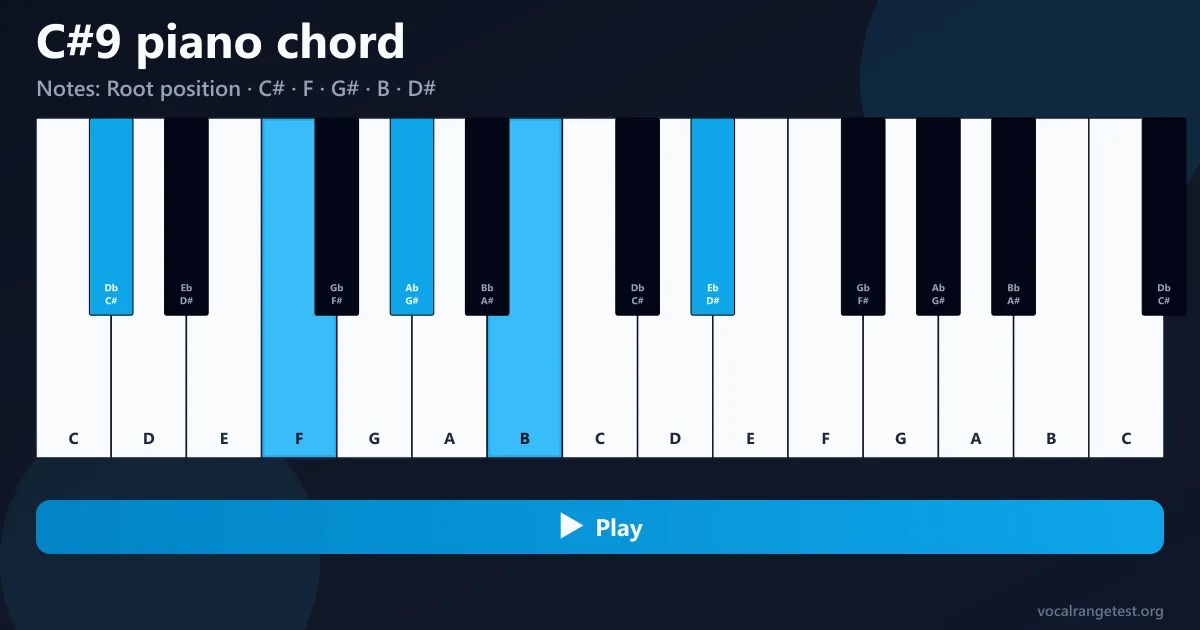
What people usually need from a Db9 chord on piano
Most players who open a chart with Db9 are sitting in Db, Ab, or Gb and need five notes that work under a melody — not a lecture. The job of this chord is softer than a plain Db7 and fuller than a triad: the flat seventh (Cb) still pulls toward resolution, while the ninth (Eb) adds a polished top that shows up in R&B pads, neo-soul left hands, gospel turns, and quiet jazz endings. A common mix-up is reading Db9 as “Db major plus any high note.” That is closer to Dbadd9, which keeps a major triad and skips the flat seventh. Another mix-up is swapping Db9 for Dbmaj9: maj9 keeps a major seventh (C natural against Db), which floats; Db9 keeps the bluesy pull of the dominant seventh and then dresses it with the ninth. If your chart says Db7 and you add Eb on top, you have effectively built the same colour — the “9” in the symbol is simply the writer telling you that top note belongs in the voicing.
We built this tool because mute screenshots waste practice time. You can press play and hear the full Db9 stack, then switch to arpeggio mode so each tone lines up under your ear: root, third, fifth, flat seventh, ninth. Left- and right-hand fingerings update as you change voicing, and inversion controls let you put F, Ab, Cb, or Eb in the bass without guessing which slash mark still sounds like a ninth chord. That combination — online listening, chord breakdown, fingerings, and inversions on one free page — is the difference between copying a picture and knowing the sound before rehearsal. Match the spelling to the rest of the bar: flat-key songbooks prefer Db9; sharp-side charts in C# or F# often keep C#9 so the accidentals stay tidy. Your hands do not care which ink the arranger chose.
Five tones, one job
Root, major third, perfect fifth, minor seventh, major ninth. Lose the flat seventh and you drift toward add9 colour; keep it and the chord still wants to resolve like a dominant.
Cb is not a trick question
In Db9 spelling, Cb is the white key normally called B. Flat-key charts write Cb so the seventh degree stays spelled as a C of some kind. Same pitch either way.
Sound first, then stretch
Audition the stacked chord and the broken arpeggio here, lock a fingering, then try inversions. Judging colour by ear beats memorising a silent diagram you never hear in context.
Db9 chord on piano with live sound, breakdown, and inversions
A still photo cannot tell you if the ninth sits sweetly above the seventh or turns muddy in the octave you chose. Preview the full grip, peel it into an arpeggio, confirm fingerings, then move through inversions and alternate bass on the same page.

Hear the full ninth, then isolate the top two tensions
Start with the stacked Db9 so your ear learns the colour as one object — warm third, pulling flat seventh, bright ninth on top. Switch to arpeggio mode when you need to confirm Cb and Eb (or B and D# in C#9 spelling) without the other voices covering them. Left- and right-hand fingerings follow each voicing, so the stretch you hear is the stretch you will practice at the bench.
- Real piano samples as a full chord or rising arpeggio
- Left- and right-hand fingerings that update with each voicing
- Root position plus inversions with F, Ab, Cb, or Eb in the bass
- Alternate bass when a chart writes a slash outside the basic set
- Same ninth sound whether the sheet says Db9 or C#9
How to play Db9 chord on piano

1. Build Db7 first, then park the ninth on purpose
Find Db, F, Ab, and Cb — that is your dominant seventh. Add Eb above or beside the stack so the ninth has a clear seat rather than an accidental cluster. If you think in sharps, build C#, F, G#, B, then D#. Play all five together once, then alone, until the top Eb (or D#) feels chosen.

2. Decide how close you want the ninth to sit
In a tight midrange grip, Eb can sit right next to Cb and feel thick. Soften the top note, drop the ninth an octave higher for air, or thin the fifth if the left hand already covers Ab. The goal is a polished dominant colour, not a five-note brick that fights the melody.

3. Roll a d flat 9 piano chord until both spellings feel automatic
Use arpeggio mode to walk Db–F–Ab–Cb–Eb slowly, then at a groove tempo. Flip the mental labels to C#–F–G#–B–D# without moving your fingers. When either spelling reads cleanly, you stop freezing mid-chart when a writer switches from flats to sharps.

4. Walk inversions so the bass can move without killing the colour
Root position is only the passport photo. Putting F in the bass (first inversion) often smooths a move from Gb or Bb; Ab in the bass can feel like a pedal fifth under a right-hand ninth; Cb or B in the bass leans hard into the dominant pull; Eb in the bass puts the colourful ninth underneath and can sound almost like a soft slash chord until the upper voices clarify Db as the root. Audition each inversion here before you cement muscle memory.

5. Check alternate bass when the arrangement wanders
Some charts keep a Db9 symbol while the bass walks to a note outside the basic inversion set. Preview that slash on this page: if the ninth colour still reads, keep your right-hand voicing; if it collapses into noise, thin a middle voice or shift an inversion. Approving the sound first beats learning a stretch that fights the bass line.
6. Drop the chord into a key so the ninth has a job
In Gb major, Db9 is a classic V9 — it wants to fall to Gb. In Db major the same symbol can colour a secondary dominant or a stylish I-area turn depending on the bass. In Ab major it often dresses II or V-of-V motion in R&B and gospel writing. Play a short turnaround and swap plain Db7 for Db9 on the dominant: you will hear why arrangers reach for the ninth when they want lift without switching to a full thirteenth stack.