
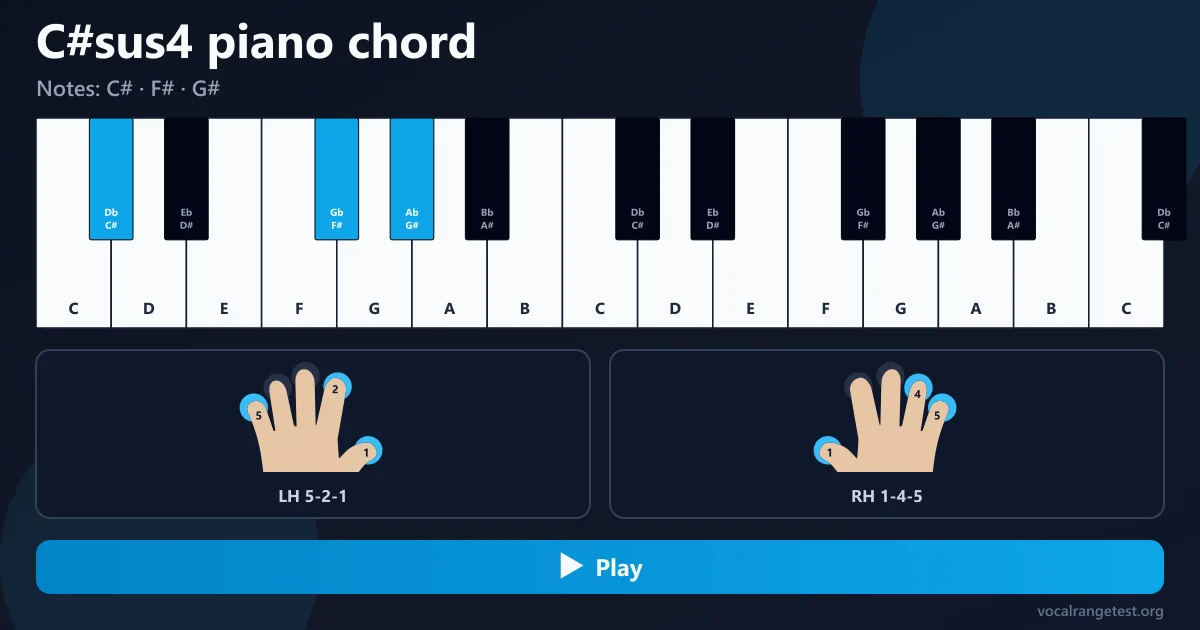
C#sus/Dbsus chord
Root position: The most common shape: the lowest note is the root named in the chord, with the other chord tones stacked above it.
Notes: C# · F# · G#
Voicing: 1 / 6
Fingering
Left hand: 5-2-1
Right hand: 1-4-5
Root
Chord type
C#sus4
C#sus2
C#/Db sus chord piano without the spelling headache
A C#/Db sus chord piano shape is the same cluster of black keys with two common names. Charts print C#sus, Dbsus, C♯sus4, or D♭sus2 and mean nearly the same family of sounds: the third of a plain triad steps aside, and either the fourth or the second takes its place. That is why the chord feels unfinished—useful unfinished—when a pad, pre-chorus, or held vowel needs air. This page keeps both spellings on one keyboard so you can hear the hang, compare sus4 with sus2, and stop guessing which black keys belong under your fingers.
What is Db sus chord piano — in plain English?
Start from a plain Db major triad: Db, F, and Ab. The F is the note that says “this is major.” Lift the F out. Put Gb where F was and you get the everyday Dbsus4 — Db, Gb, Ab. Put Eb there instead and you get Dbsus2 — Db, Eb, Ab. Same outer posts (Db low, Ab a fifth above); only the middle voice changes. Write those pitches with sharps and you are looking at C#sus4 (C#, F#, G#) or C#sus2 (C#, D#, G#). Same piano keys. Different ink. Searches for a c# sus chord piano shape and searches for a d flat sus piano chord are chasing one physical grip.
Why does this particular root show up so often? Plenty of pop, R&B, and worship charts sit in Db or Ab because the melody sits comfortably for many singers. On those pages you will see Dbsus as a color wash on the I chord, or as a soft landing before the band finally commits to Db major. In Ab major, Db is the IV chord—home for a lot of “lift into the chorus” writing—and a Dbsus there buys one extra bar of float before the major third returns. Jazz lead sheets may prefer C# spelling when the song is already full of sharps; church charts often prefer flats. Your ear does not care which office printer won. It cares whether the middle note is the fourth (tighter pull back to major) or the second (wider, calmer pad).
Db sus 4 piano chord — the default chart reading
When a lead sheet simply says Dbsus or C#sus, players almost always mean the sus4 stack: root, fourth, fifth. On the keys that is Db–Gb–Ab (or C#–F#–G#). The Gb sits one fret’s worth of tension above the major third F, so when you finally play F again the room feels like it exhaled.
Db sus 2 piano chord — same posts, quieter middle
Db–Eb–Ab (C#–D#–G#) keeps the outer frame and swaps the fourth for the second. It often sounds more open and less “cadence-bound” than sus4—useful under long vowels, lo-fi loops, and film-style pads where you want color without a hard pull home.
Why pianists meet this shape more than guitarists
Db and C# are awkward open-string territory on guitar, so strummers often dodge them. Piano hands sit naturally on the black-key ridge. That is why rehearsal rooms hand the Dbsus pad to the keys while the guitar stays in a friendlier capo key—and why a clear piano page for this chord actually gets used.
Hear a C#/Db sus online — then break the voicing apart
A still diagram cannot prove whether Gb or Eb is doing the emotional work. Here you play the full block or a rising arpeggio, check left- and right-hand fingerings, then walk inversions and alternate bass so the same color sits under a different lowest note.

Where a C#/Db sus actually shows up in songs
Think of held intros that refuse to smile yet, bridges that hover before the chorus title line, and endings that delay the final Db or C# major. Producers use it under a sustained vocal so the harmony does not slam shut every bar. Worship teams park it on I or IV when the lyric is still asking a question. None of that requires Roman numerals first—if the major triad feels too finished for the moment, borrow the suspension, then resolve when the phrase lands.
- Live piano samples for the full chord or a note-by-note arpeggio—judge the hang by ear.
- Separate Dbsus4 / C#sus4 and Dbsus2 / C#sus2 groups so you compare colors instead of guessing abbreviations.
- Left- and right-hand fingering suggestions for root-position shapes you can screenshot at the bench.
- Inversions and alternate-bass voicings when the chart wants the same sus color with a different note underneath.
- Runs in the browser—no install, no account wall for a quick check before rehearsal.
How to play a C#/Db sus chord piano shape on this page

Lock the outer posts first
Ignore the suspended note for a second. Find a comfortable Db (or C#) and the Ab (G#) a fifth above. Both sus4 and sus2 share that frame. If those two drift, no middle note will sound like this family.

Add the middle, then hear the release
Park Gb between the posts for the everyday db sus 4 piano chord. Play the block, then the arpeggio, until every lit key matches what you hear. Switch to the db sus 2 piano chord group (Eb in the middle) and resolve both shapes into plain Db or C# major. Notice which fall feels sharper (usually sus4) and which feels softer (usually sus2).

Move the bass without relearning the grip
Open inversions or alternate-bass options when the arrangement wants Ab, Gb, or another chord tone underneath while the upper color stays suspended. That is how you keep the pad moving in a real song without treating root position as the only legal shape.