
C#/Db chord
Root position: The most common shape: the lowest note is the root named in the chord, with the other chord tones stacked above it.
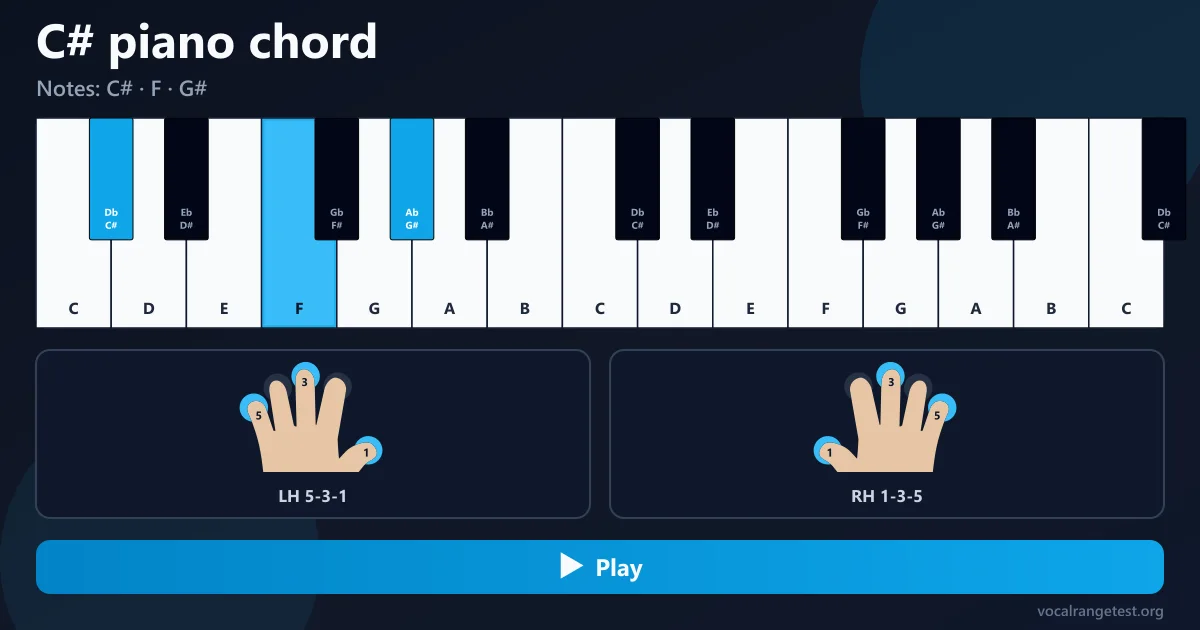
Notes: C# · F · G#
Voicing: 1 / 6
Fingering
Left hand: 5-3-1
Right hand: 1-3-5
Root
Chord type
Root position & inversions
Alternate bass
C# chord piano — black, white, black: a bright major triad that sharp-key charts refuse to respell
A C# chord piano grip is three notes: C#, F, and G#. On many keyboard diagrams F stands in for E#—same key, cleaner label for hands that already think in letter names. The shape reads black–white–black: two black posts with a white hinge between them. Players searching c sharp chord piano usually want this plain major triad, not a seventh stack. The twin spelling is Db chord piano (Db–F–Ab): identical pitches, different paperwork. Guitar tabs and sharp-side pop sheets stick with C#; flat-key jazz and brass rooms often write Db. This page stays on that one major colour so you can hear it online, break it into an arpeggio, check fingerings, and move through inversions and alternate bass without bouncing between spelling debates.
When C# shows up—and why the mood feels a little glassy
In C# major itself the triad is home: I. Sharp-key synth pop, worship charts, and guitar-led arrangements park here when neighbouring chords already live on sharps and nobody wants a sudden blizzard of flats. In F# major, C# often works as V (or thickens later into C#7) — the bright door that opens back toward tonic. You will also meet it as a borrowed major lift inside otherwise darker sharp-key songs, or as a pedal colour under a vocal while the bass walks. Emotionally C# major tends to read bright and slightly metallic—major still, but with more edge than all-white C or G. Think neon more than porch light. If you are building key of C# chords piano vocabulary, start with I in C# and V in F#; those two jobs explain most of the lead sheets that bother to print the symbol.
Theory-wise the triad is root, major third, perfect fifth. The major third (C# to F / E#) is what keeps the colour open; the fifth (G#) steadies the stack. Lower the third and you tip into C# minor. Add a flat seventh and you get dominant pull. Plain C# is the clean landing pad. On this site the diagram is tied to piano samples: hear the full chord, then split it so each tone lights in order. That listen-and-break-apart loop matters on black-key majors because soft fingertips drift toward neighbouring whites and blur the posts. Fingering updates with the voicing; inversions such as C#/F and C#/G#, plus alternate bass, stay on the same page so C# in piano practice is about sound and hand shape—not collecting mute posters.
C# and Db are the same keys
Sharp charts say C#; flat charts say Db. Learn the bright triad once, then read whichever spelling your sheet prefers.
The two black keys have to mean it
If C# or G# drifts toward a white neighbour, the triad stops reading as C# major. Chord mode proves the colour; arpeggio mode makes each post unmistakable.
Workbench tools static charts skip
Click-to-hear chord or arpeggio, left/right fingering, inversions, and alternate-bass options live together here—so rehearsal time goes into listening and placement.
A C# major workbench with the sound attached
A still photo of two black keys and one white cannot prove the major third is speaking. This page keeps the diagram linked to piano samples, fingering, inversions, and slash bass so you can trust the colour before you force a stretch.

Hear the triad, then take the hinge apart
Play a full C# when you want the complete bright ring. Switch to arpeggio when you need to isolate F between the black posts—or catch a soft finger spilling onto the wrong neighbour. Playback follows the voicing on screen, so an inversion or alternate-bass shape matches the notes you see. Online listening, broken-chord listening, fingerings, inversions, and alternate bass on one page: that is the practical difference between a thumbnail chart and a page you can practise with.
- Online piano samples for block chord or arpeggio
- Left- and right-hand fingering that updates with the voicing
- Inversions including C#/F and C#/G#
- Alternate-bass (slash) shapes when the chart puts a different note underneath
- Db spelling recognised as the same sound under flats
How to play C# chord piano

1. Plant C# and G#, then seat F cleanly between them
Find a comfortable C# (often near the black-key cluster above middle C). Add G# above it, then place F on the white key between those posts. A common right-hand set is 1–3–5; left hand often uses 5–3–1. Do not rush. The stretch is modest; honesty on the two black keys is the assignment.

2. Match your sound to the reference
Play the triad yourself, then tap chord mode on the page. Listen for whether F sits as a clear major third or disappears under heavy outer posts. If the chord suddenly feels minor or muddy, re-check the middle white key and make sure neither black key drifted.

3. Arpeggiate until the black–white–black path sticks
Switch to arpeggio and watch C#, then F, then G# light in order. Broken playback is how many players finally separate this sharp-key triad from all-white majors they learned first. Slow down until your broken pattern matches the page before you chase speed.

4. Walk the bass with C#/F
Open the inversion controls and move into C#/F—F in the bass, with G# and C# above. Charts use this when a bass line rises through the third or when a smoother middle is needed between two chords. Hear it as a block chord and as an arpeggio so the new floor note is obvious.

5. Try C#/G# for a lighter floor
C#/G# puts G# underneath. The triad tones stay the same; the gravity changes. Second inversion often feels more open and shows up when the bass wants to stay high or step into the next harmony. Compare it with root position until your ear can name the lowest note without staring at labels.
6. Preview alternate bass, then put C# in a real key
Some sheets keep a C# colour in the right hand while the bass walks outside the strict inversion set. Use alternate-bass options to preview that mismatch. Then give the triad somewhere to go: sit on I in C# major, or treat C# as V in F# and walk home. That is how key of C# chords piano study sticks—context remembers what isolated grips forget. Come back whenever you need the large diagram and the listen-and-break-apart tools again.