
C#dim/Dbdim chord
Root position: The most common shape: the lowest note is the root named in the chord, with the other chord tones stacked above it.
Notes: C# · E · G
Voicing: 1 / 3
Fingering
Left hand: 5-3-1
Right hand: 1-3-5
Root
Chord type
Root position & inversions
C#dim piano chord: a black-key grip that wants the next chord
The C#dim piano chord is C#, E, and G sounded together. That stacking is two minor thirds in a row, which leaves a bare tritone from C# up to G—the interval that keeps the harmony from sounding finished. Charts may print C#dim, C#°, C sharp dim, or the flat-side twin Dbdim. On the keyboard those spellings share the same three keys. This page lets you hear the chord as a solid block, break it into an arpeggio, read left- and right-hand fingerings, and step through inversions without opening another tab.
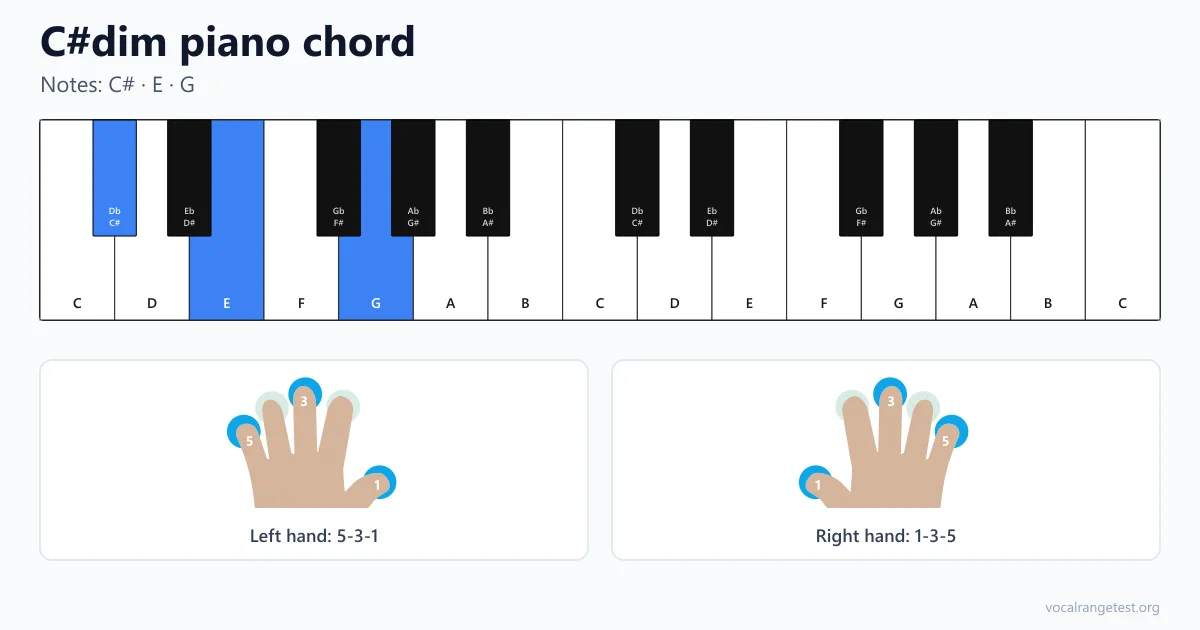
Sharp charts write C#dim; flat charts often write Dbdim
If you learned chords from guitar PDFs in D or A, you probably saw C#dim first. If you sing in brass-friendly flat keys, the same sound may show up as a Dbdim chord on piano. Neither camp is “wrong”—they are choosing ink that matches the rest of the measure. What matters under your fingers is the black key for C#/Db, the white E, and the white G. Once that shape is in the hand, the paper label can change without a new grip.
In D major and B minor, C#dim often works as the leading-tone triad (vii°). Play C#–E–G, then land on D–F#–A, and the restless cluster empties into a stable home chord. Film cues and ballads borrow that same half-step lean when a scene needs a brief chill before the downbeat. Jazz sheets sometimes stack a seventh and call it C#dim7; that thicker sonority is a different spelling and a different job. Here we stay with the three-note diminished triad and its inversions so the basic color is clear before you add extras.
Hear the tritone, not just the symbol
Tap the diagram to play C#dim as a block, then switch to arpeggio and walk C#, E, and G alone. When the hollow stretch from C# to G clicks in your ear, the chart label stops feeling abstract.
Inversions move the bass, not the pitch set
Root position keeps C# on the bottom. C#dim/E puts E underneath; C#dim/G puts G underneath. You still hear C#–E–G. Use those slash forms when a bass line needs a smoother step into D, Bm, or whatever comes next.
Fingerings ready for both hands
Each voicing shows practical left- and right-hand finger numbers so you can check a grip before you take it to a weighted keyboard or a lesson.
What is C#dim chord piano?
Straight talk for players who need the sound under their hands

The notes, counted in plain steps
From C# to E is three semitones (a minor third). From E to G is another three. From C# to G is six—the tritone that makes C sharp dim chord piano voicings feel unfinished. Teachers who write C#° still mean those same three keys. If your sheet says Dbdim instead, you are looking at the enharmonic twin: same piano keys, flat-side spelling.
How to lock in a Dbdim chord on piano using this tool

1. Plant the root-position black-key shape
Find the C#/Db black key near middle C, then E and G above it. Play the block once, listen, then run a slow arpeggio until every lit key matches what you hear. If one note blurs, mute the others and isolate it.

2. Change inversions on purpose
Switch to C#dim/E, then C#dim/G. Same three pitch classes; only the lowest note moves. Say the bass out loud—C#, E, G—so slash chords on a lead sheet stop looking like brand-new shapes.

3. Resolve so your ear learns the job
After any C#dim voicing, play a plain D major triad. Notice how the tension drops. That C#dim-to-D move is everyday work in D major and related keys. Repeat until the release feels obvious, then try easing toward Bm if you are living in B minor.