
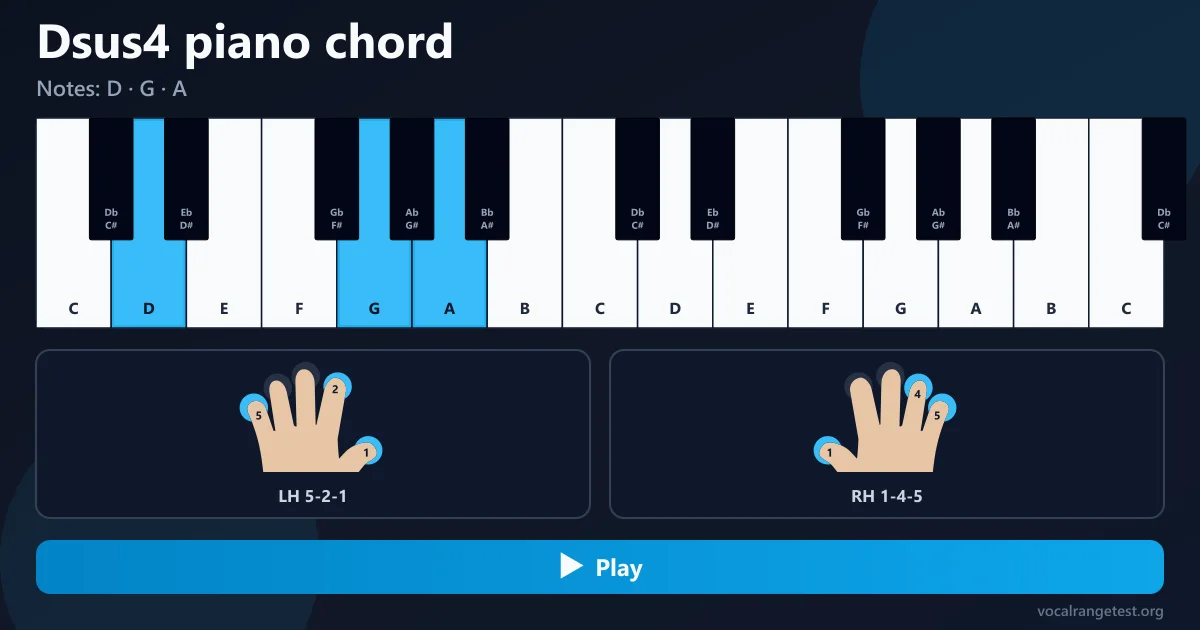
Dsus chord
Root position: The most common shape: the lowest note is the root named in the chord, with the other chord tones stacked above it.
Notes: D · G · A
Voicing: 1 / 6
Fingering
Left hand: 5-2-1
Right hand: 1-4-5
Root
Chord type
Dsus4
Dsus2
D sus chord piano without the guesswork
If you play in D a lot—worship sets, folk strums, guitar-friendly singer keys—you will meet a D sus chord on piano sooner than you expect. Charts slap “Dsus” next to a plain D and leave you staring at the black key F♯, wondering which white key stole its job. This page keeps both common answers in one place: Dsus4 (D–G–A) and Dsus2 (D–E–A), so you can hear the hang, not just memorize a diagram.
Why D major’s “smile” note gets replaced
A plain D major triad is D, F♯, and A. That F♯ is the note that makes D sound bright and finished—the little smile in the middle. A suspended D takes the smile away on purpose. Put G where F♯ was and you get the everyday d sus 4 piano chord (D–G–A). Put E there instead and you get the softer d sus 2 piano chord (D–E–A). The outer posts stay: D on the bottom of the idea, A a fifth above. Only the middle voice moves. Without a clear major or minor third, the chord does not say “happy” or “sad.” It says “not done yet.”
Players type “d sus chord on piano,” “Dsus,” or “key of d sus chords piano” when they are already living in D and need that unfinished color. Think of a chorus that sits on D for too many bars, a pre-chorus that should lean forward, or a pad under a vocal that must not resolve until the title line. Country and folk lines love the open D–A frame; worship loops in D–G–A or D–Bm–G–A borrow the same hang. You do not need Roman numerals first. You need to hear G wanting to fall into F♯, or E sitting like a quiet neighbor, then decide which story fits the lyric.
Dsus4 is the chart default
When a lead sheet writes Dsus with no number, bands almost always mean D–G–A. G sits a step above F♯ and pulls hard toward a regular D major landing.
Dsus2 is the wider, calmer hang
D–E–A keeps the same pillars but feels less urgent. Useful for pads, intros, and verses that want air instead of a shove into the next chord.
Listen, then lock the fingers
Play the block chord, split it as an arpeggio, check suggested fingerings, and flip inversions when the bass needs a different bottom note—all on this page.
What you can actually do with a D sus chord on piano
Static chord books show dots. Here you hear the full stack, break it tone by tone, and move through positions, alternate bass choices, and inversions without leaving the diagram.

When a D sus shows up in real songs
Picture a band that lives in D because guitars love open shapes there. The singer holds a long vowel on D while the piano “should” stay interesting. A plain D every bar starts to feel like a closed door. Slip in Dsus4 for a bar—G in the middle—and the door stays cracked; drop to D and the room exhales. Or start a verse on Dsus2 so E colors the harmony without stealing the bass. Film and lo-fi pads often prefer that softer stack because E is closer to a drone and less “church resolve.” None of this is fancy theory homework. It is a practical habit: if D feels finished too early, borrow the hang; if the hang sticks around too long, land on D or lean into Bm for a minor turn.
- Online piano sound for the full chord or a note-by-note arpeggio so your ear, not only your eyes, learns the shape.
- Dsus4 and Dsus2 kept in clear groups—compare the hang instead of guessing from a single symbol.
- Fingering suggestions for comfortable hand shapes in root position.
- Inversions and alternate bass so you can put A, G, or E underneath when the left hand needs to walk.
- Runs in the browser with no install and no account wall for a quick check at the bench or in rehearsal.
How to play D sus chord piano on this page

1. Plant D and A before you pick a middle note
Ignore the suspended tone for one pass. Find a comfortable D, then the A above it. Those posts belong to both Dsus4 and Dsus2. If the posts drift, the chord stops sounding like anything in the D family—fix that frame first.

2. Add G for the usual chart spelling, then try E
Drop G between D and A for the default Dsus / Dsus4 sound. Play it as a block, then as an arpeggio so each highlighted key has a voice. Switch to the Dsus2 group (D–E–A) and resolve both shapes into plain D. Notice which release feels sharper (usually sus4) and which feels softer (usually sus2). That short listen teaches the difference faster than another label on a PDF.

3. Move the bass with inversions when the line needs to walk
Root position is the learning shape. When you accompany a long stretch in D, open an inversion so a different chord tone sits on the bottom—alternate bass without inventing a new chord. Same three notes, different floor under the singer. Use the diagram’s inversion controls instead of rebuilding the grip from scratch every time the left hand wants a step.