
D9 chord
Root position: The most common shape: the lowest note is the root named in the chord, with the other chord tones stacked above it.
Notes: D · F# · A · C · E
Voicing: 1 / 4
Root
Chord type
Root position & inversions
Two-hand voicing
D9 chord piano — neo-soul’s dominant before G arrives
Neo-soul lead sheets, R&B charts, and jazz grids use D9 when a section needs dominant pull without the blunt edge of D7. Five tones: D, F#, A, C, and E — still a dominant seventh underneath, with E as the ninth on top. In G major it colours the V chord; on a D-centred vamp it can sit for bars while the band keeps moving. The tricky part on piano is not counting five keys — it is landing F# in the middle while C and E speak clearly. Here you audition root position, the chart-familiar D9/C inversion, and a two-hand spread (left D and A, right C, E, F#) on sampled piano with arpeggio and fingering diagrams.
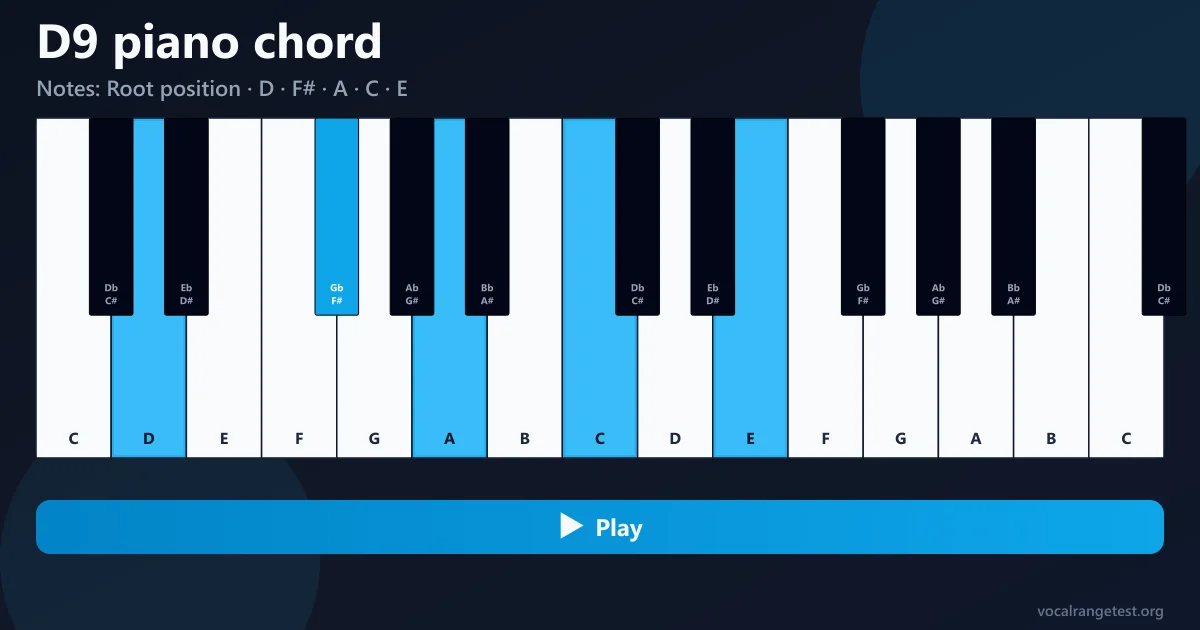
D9 on piano — F# and C are the notes that matter
Stack D7 and add E above: D, F#, A, C, E. F# is the black key between F and G — hit F natural and the chord stops being D9. C is the minor seventh that keeps dominant function; without it you drift toward Dadd9 sweetness. E is why the symbol says nine instead of seven. Players who already grip D7 add one tone. Everyone else should run the arpeggio here once and watch whether F# and C both ring before worrying about speed.
Dadd9 keeps E but drops C — pop colour, not a dominant. Dmaj9 swaps C for C# — major-ninth pastel, different pull toward G. D7 leaves E out entirely. Those swaps are one key apart on a keyboard, which is why listening beats staring at a frozen diagram. Block mode compares D9 to D7 and Dmaj9; arpeggio mode catches F natural creeping in or a ninth that never quite sounds.
F# is where D9 trips people up
Arpeggio from D upward: the moment between A and C should be F#, not F. That single black key separates D9 from a wrong triad-plus-seventh guess. Block mode against D7 makes the difference obvious in one click.
D9/C when the bass sits on the seventh
Charts often slash D9/C when a walking line or synth bass holds C while harmony still reads D9. C on the bottom, D, E, F#, and A above — darker floor, E still floating on top. Match slash symbols here before guessing from a photo.
Two-hand spread for long neo-soul comping
Left D and A, right C, E, F# — seventh, ninth, and third spread across the right hand while the root and fifth anchor the left. That layout survives eight-bar vamps without turning middle C to mud. Fingerings update when you switch voicings; arpeggio highlights run bass to treble, left hand first.
Interactive D9 — built to catch F natural before your hand memorizes it
A chord poster lists D, F#, A, C, E but cannot tell you which of those actually sounded. Sampled block and arpeggio playback, voicing thumbnails, and left- and right-hand finger numbers let you verify F#, C, and E before the shape sticks wrong.

Arpeggio mode for the F# checkpoint
Use block chord for the full neo-soul wash, then flip to arpeggio when F# might be F, when C disappears under a loud D, or when muscle memory still shapes D7 without reaching E. Keys light in play order; on the two-hand layout, finger highlights march from D and A through the right-hand cluster — the sequence you would actually play, not both thumbs on beat one.
- Sampled piano — block or arpeggio, free in the browser
- Root, D9/C, and a practical two-hand voicing
- Left- and right-hand fingerings that follow the voicing
- Thumbnail grid to audition shapes before you commit
- Five pitch classes: D, F#, A, C, and E
How to play D9 chord on piano

1. Run the arpeggio and lock F# before anything else
D, F#, A, C, E — say each name as the page plays them. F# is non-negotiable; F natural is the most common wrong note on this chord. C must speak for dominant colour; E must speak for the nine in the symbol. Guitar grips do not transfer literally — find your spacing on the keyboard.

2. Learn D9/C if your chart shows a slash
Select D9/C in the voicing grid: C lowest, then D, E, F#, A. Bass players and synth pads often sit on the flat seventh while the chord name stays D9. Listen block and arpeggio — slightly darker than root position, ninth still on top. This shape appears often enough that it deserves its own ear training, not just root position.

3. Use the two-hand layout for grooves that loop
Left hand D and A. Right hand C, E, F# — seventh, ninth, third. Standard for neo-soul and funk comping when one fist would cluster around middle C. Page fingering is typically left 5–1, right 1–2–3. Slow arpeggio: bass first, then the right-hand colour tones.

4. Root position when theory or homework asks for the full stack
D through E on the diagram answers what is inside the symbol and shows how the ninth sits above the seventh. Few gigs sustain that thick block; use it as the reference, then take songs to D9/C or the two-hand spread.

5. G major and D-centred vamps — where D9 earns its keep
Heading to G, D9 often replaces D7 as a wider V chord — same function, roomier top. On a D funk or soul vamp, D9 can hold longer without D7’s punch. Loop a passage, swap D7 for D9 for a few bars: does E add air or clutter? Clutter usually means spread the voicing or drop the root in the right hand when bass covers it.
6. New voicing on the chart? Audition it here first
Lead sheets jump between root, D9/C, and spread voicings. Pick the closest layout on this page, run arpeggio once, and let your ear veto what your eyes assumed — especially on F# and the top E.