
D chord
Root position: The most common shape: the lowest note is the root named in the chord, with the other chord tones stacked above it.
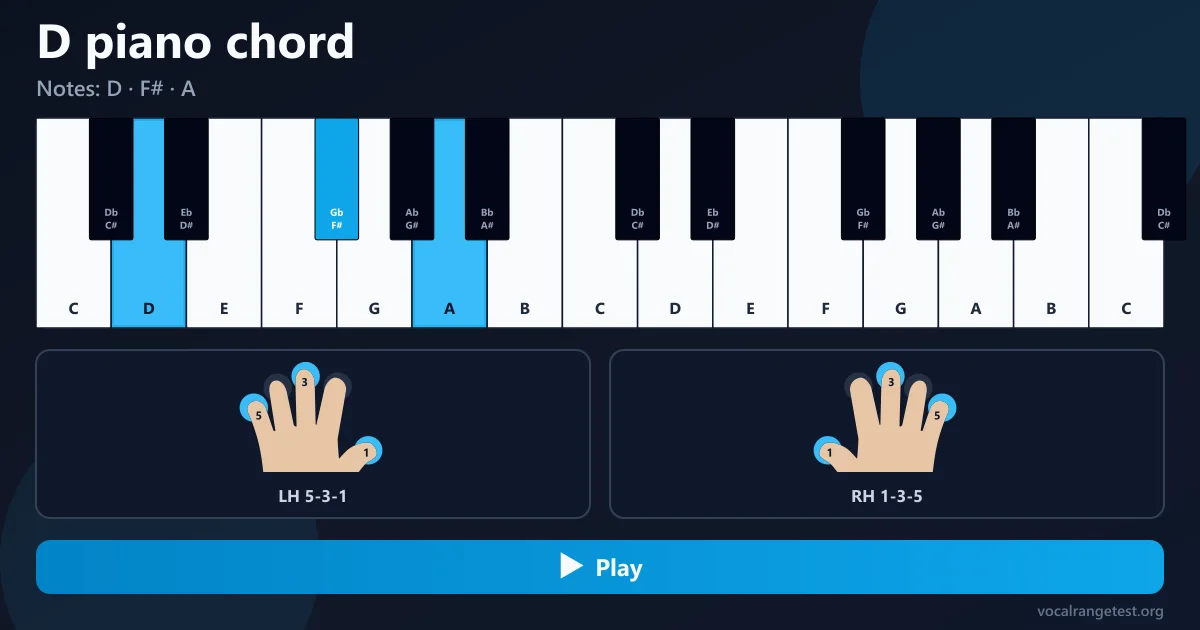
Notes: D · F# · A
Voicing: 1 / 6
Fingering
Left hand: 5-3-1
Right hand: 1-3-5
Root
Chord type
Root position & inversions
Alternate bass
D major chord piano — bright triad with two black keys that still sits under small hands
If you came here looking up D major chord piano, you already know the symbol “D” shows up constantly in folk, country, worship, and guitar-led pop. On the keyboard that chord is three notes: D, F♯, and A. Unlike an all-white-key triad, the middle tone sits on a black key, so the hand has a slight “reach and settle” feeling that is easy to feel once you hear it. This page stays on that one chord—large diagram, fingering for both hands, and playback you can trigger without leaving the bench.
Where D major shows up, and why players keep coming back to it
Songwriters lean on D major when they want lift without heaviness. Think open-road country choruses, Celtic-tinged folk, bright worship anthems, and a lot of campfire guitar tunes that never leave the key of D. The mood is usually sunny, confident, and a little pastoral—more “windows down” than “ballad in a minor key.” Fiddle and mandolin players like D because open strings ring under the harmony; piano players meet the same songs when they arrange those charts for keyboard.
On piano, D major in piano practice also teaches a useful middle step between all-white triads and denser jazz shapes. You learn to land F♯ cleanly without collapsing the wrist, keep A even with D, and then move into the bass patterns that real charts demand: D/F♯ when the bass walks up, D/A when you want a lighter fifth in the bass, and slash tones when the line keeps moving under a held right-hand D. Hearing those options online—block chord or broken arpeggio—turns a static picture into something you can match with your hands.
Built around one chord, not a poster grid
The diagram is sized for learning D itself. When you need neighbours in the key of D chords piano layout, jump to the full chart without losing the voicing you were hearing.
Click once, judge by ear
Chord mode hits D–F♯–A together so you catch the major colour. Arpeggio mode walks the tones so each blue key lines up with a pitch—especially helpful for locking that black-key F♯.
Voicings charts usually skip
Root position is only the home shape. The same page steps through inversions and alternate bass so D still sounds like D when the lowest note changes.
What makes this D major page different from a frozen chord chart
Paper and screenshots freeze one grip. Here the diagram stays tied to sound, fingering, and the bass moves you actually see in songs—so practice time goes into listening and hand shape, not guessing from a still image.

Listen online, then break the chord apart
Tap for a solid D major when you want the full bright colour in one hit. Switch to arpeggio when F♯ still feels fuzzy under the fingers—watching D, then F♯, then A light in order is faster than naming the black key in your head. Playback follows the voicing you selected, so an inversion or slash shape sounds like the notes on screen, not a generic root-position sample.
- Left- and right-hand fingering that updates with the voicing you pick.
- D/F♯ chord piano and D/A chord piano inversions with a short plain-language read of the slash.
- Alternate-bass shapes (D/C♯, D/B, D/C) for walking bass under a held D colour.
- Chord or arpeggio playback timed to the diagram and fingertip highlights.
- One tap to the full piano chart when you need every quality in the key of D.
How to play D chord piano

1. Find D near middle C, then the black key between F and G
Start with D just above middle C if the span feels comfortable; smaller hands can drop an octave. Right-hand thumb often takes that D in root position (left-hand pinky if the triad sits in the bass). The middle tone is F♯—the black key between F and G—not F natural. If your ear says the chord sounds minor or “sad,” you almost certainly landed on F instead of F♯.

2. Stack A on top and check the spacing
Skip the white key between D and F♯’s neighbourhood, then place A above. In root position many players use 1–2–5 or 1–3–5 in the right hand; left hand often mirrors 5–3–1 or 5–2–1 depending on stretch. Aim for three even tones without neighbouring keys ghosting under soft fingers. When the shape feels stable, tap the diagram in chord mode and compare your sound to the reference.

3. Hear it as an arpeggio so F♯ stops being a guess
Switch to arpeggio and tap again. Seeing each key light while the pitch climbs (D, F♯, A) is one of the quickest ways to burn the black-key landing into muscle memory. If a finger arrives late, slow down until your broken chord matches what the page plays.

4. Add the inversions you’ll see as D/F♯ and D/A
Use the voicing controls to move into first and second inversion. A D/F♯ chord piano shape keeps D–F♯–A but puts F♯ in the bass—very common when a bass line rises D → D/F♯ → G. D/A chord piano puts A underneath for a lighter, suspended-feeling arrival that still reads as D major. Listen in both chord and arpeggio modes so the new lowest note is obvious before you copy it.

5. Try alternate bass when the chart keeps walking
Slash chords with a tone outside the triad (D/C♯, D/B, D/C on this page) show up when the bass keeps stepping while the right hand holds D major colour. Diagram and audio include that extra bass note, so you hear four pitches, not three. Play them after the plain inversions so you can tell “same chord, new bass” from “new chord quality.”
6. Branch into the key of D when you need neighbours
Open the full-chart tab and stay on the D row: minor beside major, then the sevenths. That is how key of D chords piano study usually grows—D, Em, F♯m, G, A, Bm—without abandoning the home triad you just locked in. Come back to this single-chord page whenever you want the large diagram and inversion set again.