
Ddim chord
Root position: The most common shape: the lowest note is the root named in the chord, with the other chord tones stacked above it.
Notes: D · F · G#
Voicing: 1 / 3
Fingering
Left hand: 5-3-1
Right hand: 1-3-5
Root
Chord type
Root position & inversions
Ddim chord piano for players who need the tense middle, not a pretty postcard
D diminished sits on D, F, and G♯. Nothing about that trio wants to lounge. If your chart flashes Ddim, D°, or Do for a bar — or half a beat — this page lets you audition the grit before your hands commit.
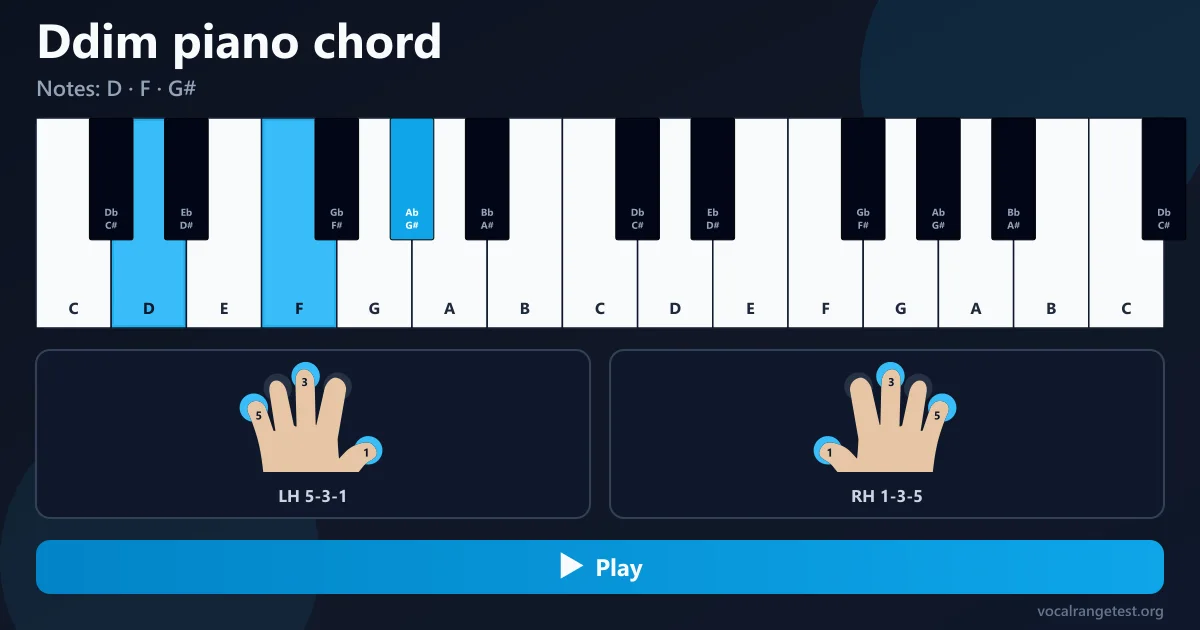
What is a Ddim chord on piano?
Strip the jargon and a D diminished piano chord is three keys: D at the bottom of the root-position shape, F a minor third above, and G♯ another minor third above that. The wide jump from D up to G♯ is a tritone. That interval is why the chord sounds like it is leaning out of its chair. Your ear keeps waiting for the next harmony to catch it.
Publishers swap spellings. Some charts write the top note as A♭ instead of G♯. Same black key under your finger; different story on the page. G♯ often appears when the music is heading toward A or E territory. A♭ shows up when E♭ or A♭ major/minor is nearby. Either way, the ddim piano chords you hear on recordings are those three pitch classes. The four-note label Ddim7 is a different animal — it keeps the triad and stacks one more minor third on top. If the lead sheet only says Ddim, learn the triad first so you do not automatically add a seventh the band never wrote.
A push toward E♭ (and friends)
In classical habits, Ddim often behaves like the leading chord into E♭ major or E♭ minor — every tone wants to nudge up a half step. Pop charts borrow the same idea for a single dramatic lift.
Passing glue between stronger chords
Think D major → Ddim → D minor, or a walk from C♯ something into D. The diminished hit is the hallway, not the room you live in.
Spellings follow the destination
If the next chord is rich in flats, writers may prefer A♭ in the spelling. If sharps dominate the bar, G♯ stays. Train your eyes for both so sight-reading does not stall.
Tools on this page that a flat diagram cannot give you
You can ring Ddim as one attack, spill it as an arpeggio, read left- and right-hand finger numbers, and step through inversions plus alternate-bass labels the way real parts are written.

Sound first, then the print
Chord playback shows the full crunch of D–F–G♯. Arpeggio mode isolates each tone so you can hear how the G♯ scrapes against D — the detail that makes diminished different from plain D minor (which would keep an A, not a G♯).
- Online piano samples for Ddim without installing software
- Break-apart (arpeggio) listening beside the block chord
- Fingering guides for left and right hand on each shape
- Inversions and slash bass such as Ddim/F and Ddim/G♯
- Jump to related roots and qualities from the same screen
Working Ddim into your hands without guessing

1. Compare it to D minor on purpose
Play D–F–A (D minor), then D–F–G♯ (Ddim). That single swap from A to G♯ is the whole plot. Once your ear owns the difference, the symbol on the page stops feeling abstract.

2. Follow the bass the chart demands
Root position keeps D underneath. Ddim/F puts F in the bass when a line is already sitting on F. Ddim/G♯ puts the tritone tone on the bottom — useful when a bass walk or inner voice is parked on G♯/A♭. Switch voicings here until the lowest note matches the slash.

3. Rehearse the exit, not only the hit
Hold Ddim for one beat, then land on E♭ major, D minor, or A7 — whichever your song uses. Diminished chords teach timing: how long you squeeze the tension, and which chord takes the weight afterward.