
Dm9 chord
Root position: The most common shape: the lowest note is the root named in the chord, with the other chord tones stacked above it.
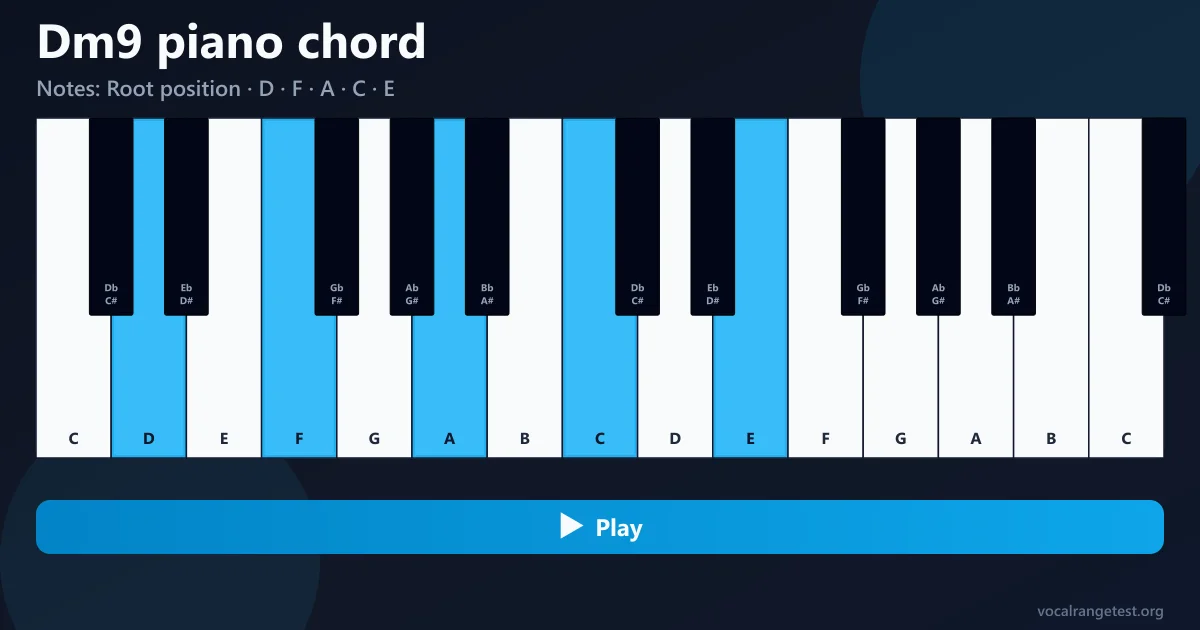
Notes: D · F · A · C · E
Voicing: 1 / 4
Root
Chord type
Root position & inversions
Two-hand voicing
Dm9 piano chord — five white keys that sound like late-night R&B, not a theory exam
Someone lands on this page because a chart wrote Dm9 and they need to know what to press — or because they heard a warm, slightly jazzy minor colour in a neo-soul track and want to copy it at the keyboard. Dm9 stacks a minor triad (D–F–A), adds the minor seventh C, then places E as the ninth on top. Every pitch is a white key, which surprises people who expect “jazz chords” to mean black keys everywhere. The real work is spacing: five tones in one fist turns muddy fast, and the E on top is easy to drop when you are still thinking in Dm7. This page lets you hear the full stack, break it note by note, switch to Dm9/C when the bass sits on C, and try a practical two-hand layout before you commit muscle memory at the bench.
What Dm9 actually is — and why it shows up on real charts
Start with Dm7 (D–F–A–C) and add E above the seventh. That E is the “9” in the symbol — not a random extra note, but the tone that opens the chord upward and gives it that cushioned, slightly nostalgic feel you hear in Sade-adjacent ballads, quiet neo-soul grooves, and jazz-leaning pop when the writer wants minor colour without the blunt sadness of a plain triad. In F major, Dm9 often works as a richer vi chord under a vocal that has room to breathe. In D minor itself it can sit as i9 for bars while the melody floats. You will also see it where a progression already used Dm7 and the arranger wanted one more layer of air — same minor foundation, gentler top.
Do not confuse it with neighbours that look similar on paper. Dm7 stops at C — still minor, still movable, but without the floating E. Dmaj9 swaps C for C♯ and flips the whole personality toward major-ninth pastel. Dm(add9) keeps E but drops the seventh, which reads sweeter and less “jazz functional.” D9 is a dominant chord built on D (D–F♯–A–C–E) — totally different job in a progression. On piano, the mistake that actually happens is not wrong accidentals — it is cramming five notes into a tight cluster so C and E disappear under a heavy D and F. Hearing block and arpeggio playback here shows whether all five pitch classes are speaking before you take the shape into a song.
All white keys — spacing is the hard part
D, F, A, C, and E need no sharps or flats. The challenge is fitting them without crushing the top two tones. The diagram and two-hand voicing give you layouts that keep E audible instead of buried.
Dm9/C when the seventh owns the bass
Charts and walking bass lines often slash Dm9/C when C sits underneath while the harmony still reads Dm9. C on the floor, D through A stacked above — darker entry, ninth still floating on top. Audition it here before guessing from a static image.
Two-hand spread for grooves that loop
Left hand D and A, right hand C, E, F — seventh, ninth, and third spread while root and fifth anchor the bass. That layout survives comping on an eight-bar vamp without turning middle C into mud.
Why we built this page — listen online, pull the chord apart, move the bass
Most Dm9 diagrams online are a frozen screenshot of five keys. They cannot tell you whether your E actually rang, whether C is functioning as the seventh, or how Dm9/C should sound when a slash mark appears mid-chart. We tied the diagram to sampled piano audio, arpeggio playback that lights each key in order, left- and right-hand fingering that updates when you change voicing, and a small set of inversions you will meet in lead sheets — so rehearsal time goes into hearing and placement, not decoding a mute picture.

Hear the chord whole, then hear each note alone
Chord mode plays the voicing you selected — root stack, Dm9/C, or the two-hand spread — so you know what “done” sounds like before your fingers copy it. Arpeggio mode walks the tones in play order and lights each key as it sounds. That split is the fastest way to catch a missing E, a seventh that never spoke, or a hand shape that looks right but blends into grey noise. Playback follows the voicing on screen, not a generic root-position loop, which matters when you are comparing how Dm9 feels against Dm9/C for the first time.
- Click-to-hear block chord or arpeggio on real piano samples
- Left- and right-hand fingering that changes with the voicing
- Root position, Dm9/C inversion, and a practical two-hand layout
- Voicing thumbnails to audition shapes before you commit
- Five pitch classes: D, F, A, C, and E — all white keys
How to play dm9 chord on piano

1. Name the five tones before you stretch
Dm9 is D, F, A, C, and E — root, minor third, fifth, minor seventh, major ninth. Say each name while the page plays them in arpeggio. F must be natural (not F♯) or you are in a different chord family. C must read as the seventh, not an optional colour note. E must ring for the symbol to mean nine, not seven. Guitar tab or a phone screenshot will not tell you if your spacing hides the top — use the diagram as the map.

2. Hear root position once, then decide if you need it on stage
Root position stacks D through E in one region of the keyboard. It answers theory homework and shows how the ninth sits above the seventh. Few gigs sustain that thick block for long; treat it as the reference sound, then move to a voicing that fits your hand. Play block mode, then arpeggio, and notice which tone drops out when you rush — usually E or C.

3. Switch to the two-hand layout for real comping
Select the two-hand voicing: left D and A, right C, E, F. Fingerings on the page typically run left 5–1, right 1–2–3. Slow arpeggio from bass to treble — bass notes first, then the right-hand cluster — mirrors how you would actually voice this in neo-soul or quiet R&B. The chord still reads Dm9 when the root is in the left and the colour tones breathe in the right.

4. Learn Dm9/C when the chart shows a slash
Dm9/C puts C in the bass: C lowest, then D, E, F, A above. Bass players and synth pads often sit on the flat seventh while the chord name stays Dm9. It sounds slightly darker than root position with the ninth still on top. Run block and arpeggio here until your ear owns the new floor note — slash chords confuse players who only drilled root position.

5. Place Dm9 in a key so the colour makes sense
In F major, try hanging on Dm9 as vi9 under a melody, then resolve toward B♭ or back to F — you will hear why arrangers reach past plain Dm7 for one more shade of warmth. In D minor, sit on i9 for a few bars and notice how the ninth adds lift without the dominant pull of D9. Context beats isolated drilling; return here whenever a new voicing appears on a chart you have not practised.
6. Use fingering view after your ear approves the shape
Open the fingering panel for each voicing and match it to your span. Small hands should not force five notes into one cramped cluster — split across hands or use Dm9/C if the bass line allows. If block playback and your live attack disagree, trust the page first, adjust pressure second, speed last.