
E chord
Root position: The most common shape: the lowest note is the root named in the chord, with the other chord tones stacked above it.
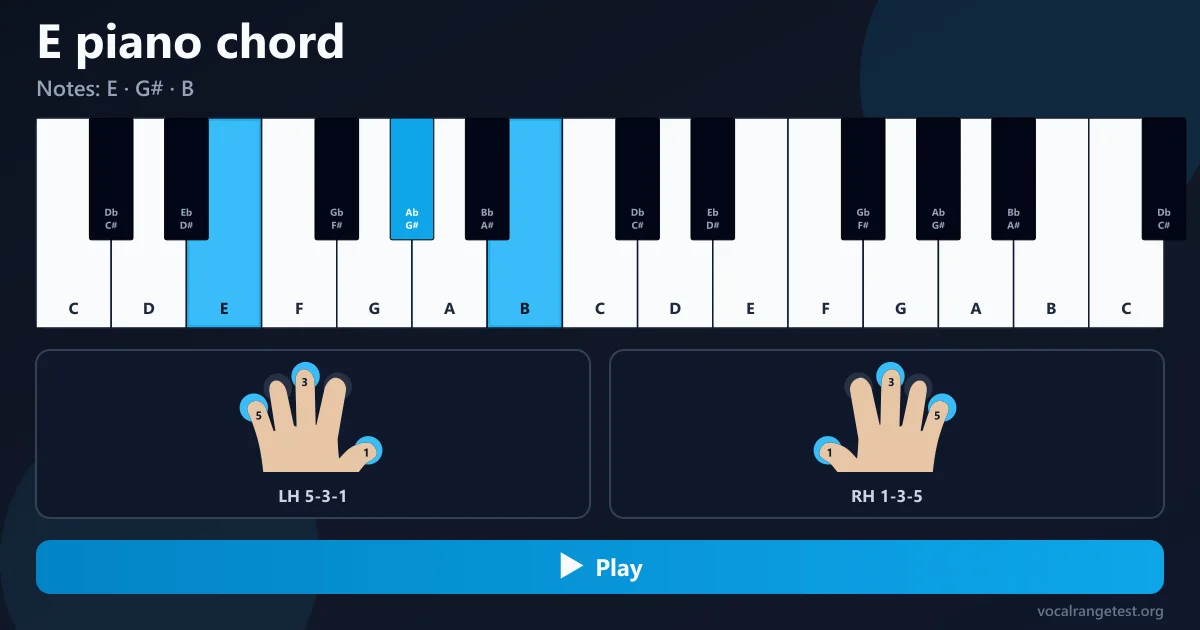
Notes: E · G# · B
Voicing: 1 / 6
Fingering
Left hand: 5-3-1
Right hand: 1-3-5
Root
Chord type
Root position & inversions
Alternate bass
E major on the keys — three tones, one black key, and a colour that cuts through a mix
Players land on this page because lead sheets keep printing a plain “E,” and they want that sound under their fingers before the next rehearsal. An e major chord piano shape is E, G♯, and B — two white keys wrapped around a sharp that sits on a black key. That middle tone is what separates a ringing major from an accidental minor when a tired hand drifts flat. You will not get a wall of unrelated chords here. You get one triad, sized large, with playback you can trigger from the bench and fingering that updates when you change how the bass sits.
Why songwriters keep parking songs in E
E major shows up when a track needs voltage. Think stadium choruses, blues shuffles that lean on open-string guitar habits, praise bands that want lift without a dense flat-key fog, and a surprising number of singer-songwriter intros that start with a single ringing E before anything else moves. Compared with warmer pastoral keys, E often feels brighter and a little more “forward” — the kind of colour that reads as confident, declarative, even slightly electric even when you are only on acoustic piano. Guitarists love E because open strings ring under it; pianists inherit those same charts and suddenly have to own the G♯ cleanly instead of fretting an open shape.
Learning e major in piano practice is also an honesty check for hand independence. The triad itself is small, but charts in the key of E rarely leave you in root position for long. Bass lines walk, worship medleys modulate, and rock ballads ask for E/G♯ when the left hand needs to climb without changing the harmony’s identity. Hearing block chords and broken patterns on this page turns those slash marks from theory jargon into something your ear can veto or approve before your fingers copy them.
Built for one triad, not a poster dump
The diagram stays zoomed on E so you can judge spacing and colour. When you need the wider grid for key of e chords piano study, the full chart is one click away without abandoning what you just heard.
Ears first, then muscle
Chord playback stacks E–G♯–B so the major third is unmistakable. Arpeggio playback walks the same tones so each lit key matches a pitch — useful when G♯ still feels like a guess.
Bass moves without renaming the chord
Root position is home. The same tools surface inversions and alternate bass so the harmony still reads as E when the lowest note is no longer E.
A working E major lab, not a static screenshot
Printed charts freeze one grip. This page keeps the diagram tied to piano samples, left- and right-hand fingering, inversions, and the alternate-bass shapes that real lead sheets actually print — so practice time goes into listening and placement, not decoding a mute JPEG.

Hear the chord, then break it open
Tap once for a solid E major when you want the full ring. Switch to arpeggio when you need to isolate whether G♯ is truly speaking or whether a soft finger is leaking toward G natural. Playback follows the voicing you selected, so an inversion or slash shape sounds like the notes on screen instead of a generic root-position loop. That listen-and-compare loop is the difference between memorising a picture and recognising the chord in a song.
- Fingering for both hands that updates with the voicing you choose.
- E/G# chord piano and E/B chord piano inversions with a plain-language read of the slash.
- Alternate-bass options (E/D♯, E/C♯, E/D) for walking lines under a held E colour.
- Chord or arpeggio playback synced to the diagram and fingertip highlights.
- Quick jump to the full piano chart when you need neighbouring qualities in E.
How to play E chord piano

1. Plant E, then claim the black key for G♯
Find an E near middle C if the stretch feels honest; smaller hands can drop an octave without changing the chord’s identity. In root position the right-hand thumb often takes that E (left-hand pinky if the triad is living in the bass). The middle tone must be G♯ — the black key between G and A — not G natural. If the chord suddenly sounds bluesy-sad or “minor-ish,” you almost certainly flattened the third. That single correction fixes more beginner E majors than any other tip.

2. Add B on top and balance the three voices
Place B above so the triad reads E–G♯–B upward. Many players use 1–3–5 or 1–2–5 in the right hand; the left often mirrors 5–3–1 or 5–2–1 depending on stretch. Aim for three even attacks with no neighbouring keys ghosting under soft fingertips. When the shape feels stable, trigger chord mode on the diagram and compare your tone to the reference — especially the brightness of that G♯ against E and B.

3. Switch to arpeggio until the third stops being a guess
Arpeggio mode lights each key as the pitch climbs. Watching E, then G♯, then B fire in order is one of the fastest ways to lock the black-key landing into muscle memory. If one finger arrives late, slow down until your broken chord matches the page. This is also where e major chord piano practice starts to feel musical instead of purely positional: you hear the harmony assemble, not just a block stamp.

4. Move into E/G♯ and E/B when the bass needs to walk
Use the voicing controls for first and second inversion. An e/g# chord piano shape keeps E–G♯–B but puts G♯ underneath — common when a bass line rises E → E/G♯ → A without changing the chord quality. An e/b chord piano voicing parks B in the bass for a lighter, sometimes more “suspended-feeling” arrival that still functions as E major. Listen in both chord and arpeggio modes so the new lowest note is obvious before you copy the grip.

5. Try alternate bass when the chart keeps stepping
Slash chords with a tone outside the triad — E/D♯, E/C♯, and E/D on this page — appear when the bass keeps walking while the right hand holds E major colour. Diagram and audio include that extra bass note, so you hear four pitches, not three. Practice them after the plain inversions so your ear can tell “same chord, new bass” from “new chord quality.” That distinction saves a lot of rehearsal confusion when someone calls “E over D-sharp” from across the room.
6. Expand into the key of E when you need neighbours
Open the full-chart tab and stay on the E row: minor beside major, then the sevenths. That is how key of e chords piano vocabulary usually grows — E, F♯m, G♯m, A, B, C♯m — without abandoning the home triad you just secured. Come back to this single-chord page whenever you want the large diagram, the inversion set, and the listen-and-break-apart tools again.