
Esus chord
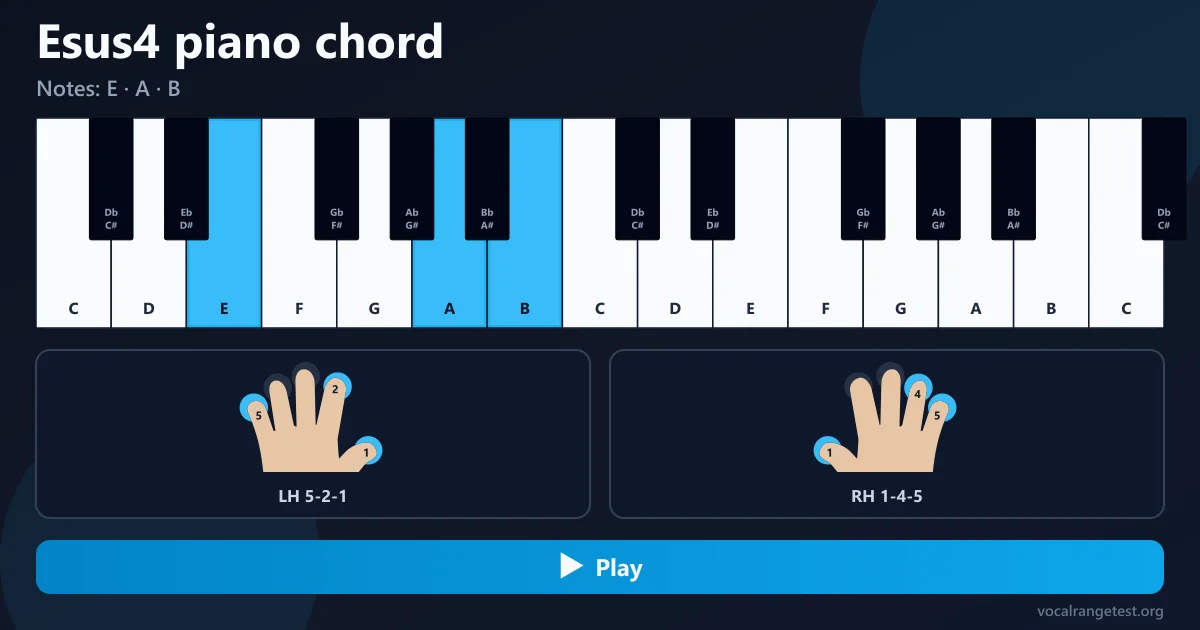
Root position: The most common shape: the lowest note is the root named in the chord, with the other chord tones stacked above it.
Notes: E · A · B
Voicing: 1 / 6
Fingering
Left hand: 5-2-1
Right hand: 1-4-5
Root
Chord type
Esus4
Esus2
E sus chord piano for players who already live in E
E is a home key for a lot of bands: open guitar strings, power-chord riffs, and singer ranges that sit comfortably there. That is why an e sus chord piano shape shows up in charts even when the pianist never asked for theory class. Someone wrote Esus beside a plain E, and now you need to know which middle note moved. On this page you get both everyday answers—Esus4 (E–A–B) and Esus2 (E–F♯–B)—with sound attached, so the symbol stops being a mystery.
Pull the bright G♯ out of an E triad
Regular E major is E, G♯, and B. G♯ is the shiny middle note; it is also a black key, so beginners feel it under the hand even when they are not sure of the name. Suspended E removes that shine on purpose. Slide A into the middle and you have the chart-default e sus 4 piano chord: E–A–B. Slide F♯ in instead and you have the gentler e sus 2 piano chord: E–F♯–B. Outer posts stay put—E as the floor of the idea, B a fifth up. Only the filler changes. Without a clear major or minor third, the chord will not smile or frown for you. It waits.
Searches like “e sus chord on piano” or “key of e sus chords piano” usually mean you are already camping in E and need that waiting color. Rock intros that hover before the riff lands, worship tags that refuse to close on a bright E too soon, bridge pads under a long held vowel—those are classic homes for the hang. Guitarists often feel sus in the fretting hand first; pianists meet the same idea as white-key A replacing black-key G♯, or as F♯ nestled between E and B. Either way, your job is simple: hear how hard A wants to fall back toward G♯ (into E major), or how F♯ sits like a quiet neighbor, then pick the one that matches the line.
Esus / Esus4 — the usual chart shorthand
Bare “Esus” on a lead sheet almost always means E–A–B. A is the fourth; it creates a strong lean back into E major when you finally release.
Esus2 — same pillars, softer middle
E–F♯–B keeps E and B but feels less pushy. Handy for pads, ambient layers, and verses that need width without a big resolve gesture.
Sound first, spelling second
Play the full chord, break it into an arpeggio, glance at fingerings, then move bass notes with inversions when the left hand needs to walk.
Where an E sus earns its keep (and how this page helps)
A paper diagram cannot prove the hang. Here you listen online, split the tones, check hand positions, and explore alternate bass plus inversions in one view.

Song situations that call for the hang
Think of a chorus that has already stated E too many times. Another plain E sounds like slamming a door. Park Esus4 for a bar—A in the middle—and the door stays ajar; drop to E and the air moves again. Or open a verse on Esus2 so F♯ colors the harmony while the bass still feels like home. Arena-rock builds love that suspended beat before the downbeat hits. Quiet singer-songwriter sections often prefer sus2 because it widens the chord without sounding like a church cadence. Bluesy melody lines that already flirt with F♯ may lock better with Esus2 than with A in the middle. Rule of thumb in plain speech: if E feels done too early, borrow the hang; if the hang overstays, land on E or tip into C♯m for a minor shade.
- Live piano playback for the full stack or a note-by-note arpeggio.
- Esus4 and Esus2 grouped separately so you compare hangs, not guess from one abbreviation.
- Fingering guidance for root-position comfort.
- Inversions and alternate bass for smoother left-hand motion under a long E section.
- Works free in the browser—no app install, no account gate for a quick check.
How to play E sus chord piano on this page

1. Lock E and B as your frame
Before you argue about A versus F♯, plant E and the B above it. Those two notes belong to both suspended flavors. If the frame is wrong, no middle note will rescue the sound.

2. Hear Esus4, then Esus2, then resolve both to E
Add A for the everyday chart spelling (Esus / Esus4). Play the block once, then switch to arpeggio so each glowing key has a voice. Open the Esus2 group (E–F♯–B) and resolve both shapes into plain E major. Notice which landing feels like a stronger drop (often sus4) and which feels like a soft fade (often sus2). That listen is the real lesson.

3. Shift the bass with inversions when the groove needs motion
Root position teaches the spelling. When you accompany a long stretch in E, flip an inversion so B, A, or F♯ can sit underneath—alternate bass without inventing a new chord name. Same three tones, different floor under the vocal. Use the on-page inversion controls instead of rebuilding the shape every time the left hand wants a step.