
Edim chord
Root position: The most common shape: the lowest note is the root named in the chord, with the other chord tones stacked above it.
Notes: E · G · A#
Voicing: 1 / 3
Fingering
Left hand: 5-3-1
Right hand: 1-3-5
Root
Chord type
Root position & inversions
Edim chord piano when the chart asks for tension on E, not another Em
Edim is E, G, and A♯ stacked as a triad. Players who only know E minor keep reaching for B by habit. This page is for catching that mistake early — hear the thinner, sharper color, then copy the shape your arrangement actually printed.
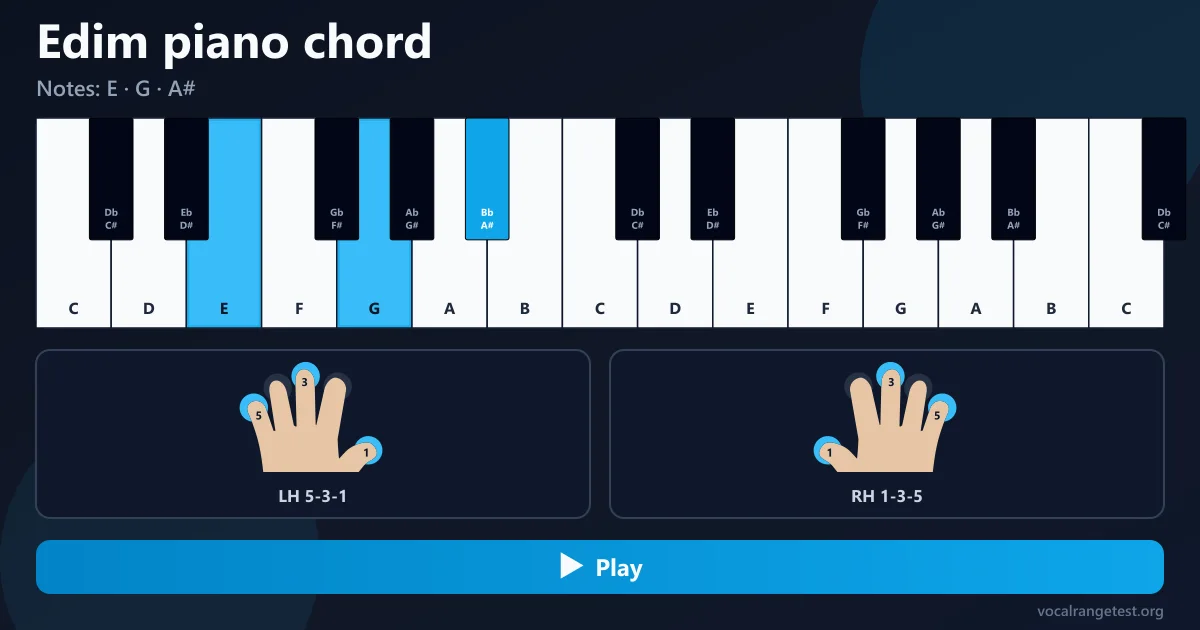
What is an Edim chord on piano?
An edim chord on piano is the diminished triad built on E. From E, climb a minor third to G, then another minor third to A♯. Those three notes form two equal steps and one awkward outer interval: the tritone between E and A♯. That scrape is the whole personality of the chord. Soft Em uses E–G–B. Edim lowers the fifth idea into A♯ (the same key many sheets call B♭). One changed pitch, completely different job in the song.
You will meet the e diminished chord piano label as Edim, E°, or Eo. Strict theory sometimes prefers B♭ in the spelling when the music is swimming in flats; A♯ appears when sharps are already in the key signature or the line is drifting toward B. Under the hand it is the same black key. Separately, Edim7 adds one more minor third above the triad — a four-note crunch. If the part only shows Edim, master the three-note version before you volunteer the seventh.
The quiet link into F
In F major or F minor, Edim often acts like a springboard: each tone wants to tip up a half step into an F triad. Songwriters steal that lift for a single heartbeat before the tonic lands.
Hidden inside a C7 sound
E–G–B♭ is also the top of a C7 chord with the C removed. When a band implies dominant harmony, a pianist sometimes grabs Edim shapes as a compact stand-in while the bass already covers C.
A♯ versus B♭ on the page
Same key, different ink. Train yourself to accept both spellings so a hymn in flats and a jazz chart in sharps do not feel like two unrelated chords.
What you can do here that a screenshot of Edim cannot
Ring the full triad, break it into a slow arpeggio, check left- and right-hand finger numbers, then move through inversions and slash-bass labels the way lead sheets actually write them.

Ear check against E minor in seconds
Play Em in your head (or on another tab), then trigger Edim here. The missing B and the A♯ bite tell you immediately whether you have the diminished quality or slipped back into a minor triad.
- Browser piano audio for Edim — no plugin install
- Chord hit or note-by-note (arpeggio) breakdown
- Fingering maps for each hand that follow the selected voicing
- Inversions and alternate bass: Edim/G, Edim/A♯
- Root and quality navigation without abandoning the listening tool
Getting Edim under your fingers on this keyboard

1. Plant E and G, then add the trouble note
Most pianists already own E and G from Em or C major shapes. Add A♯ last and listen for the sudden lean. Loop E–G–A♯ as an arpeggio until the top note stops surprising you.

2. Pick the bass your slash chord names
Root position keeps E low. Edim/G puts G underneath — handy when a left-hand line or a bass player is already on G. Edim/A♯ parks the unstable tone in the basement, which can make the next chord feel like a bigger landing. Flip voicings on this page until the lowest note matches the chart.

3. Practice the handoff into F or C7 territory
Play Edim for one beat, then F major; or Edim into a full C7. Those two exits cover a huge amount of real repertoire. Timing the squeeze-and-release teaches more than staring at a static fingering chart.