
Em9 chord
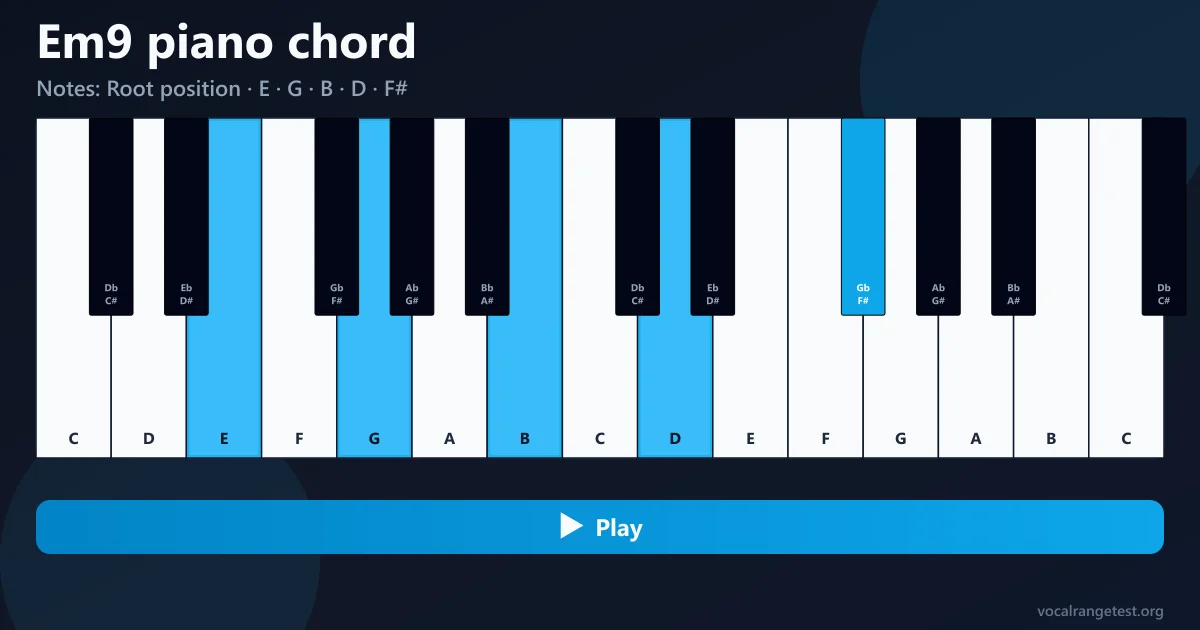
Root position: The most common shape: the lowest note is the root named in the chord, with the other chord tones stacked above it.
Notes: E · G · B · D · F#
Voicing: 1 / 4
Root
Chord type
Root position & inversions
Two-hand voicing
Em9 piano chord — the soft lift that turns a plain Em into something you actually want to leave ringing
People look up the Em9 piano chord for a simple reason: a chart or DAW session wrote Em9, and Em alone suddenly felt too blunt. Em9 keeps the minor color of E–G–B, adds the seventh D, then hangs F# on top like a small open window. That F# is why the chord feels roomy instead of heavy. This page is here so you can hear that stack, pull it apart note by note, and try the shapes you will meet on real charts—not just stare at a frozen key diagram.
What Em9 actually is (without the textbook fog)
Start from Em7: E, G, B, and D. That already sounds like a song that breathes. Em9 is the same stack with F# sitting above the seventh. In interval talk that F# is the major ninth—nine steps up from E if you count along the scale—but you do not need the jargon to use it. On the keyboard you are looking for five pitch names: E, G, B, D, and F#. Four of them are white keys. F# is the black key tucked between F and G, and that single black key is the whole personality shift. Leave it out and you are still on Em7. Play G# instead of G and you have wandered into E9 territory, which is a dominant chord with a brighter, more pushy job in a progression.
You will hear Em9 a lot where writers want minor warmth without sounding stuck in a sad triad—neo-soul pads, soft rock bridges, indie ballads, quiet R&B loops, and piano parts that are covering a guitar chart. In E minor it can sit as a richer home chord for a few bars. In G major it often shows up as the vi chord when the songwriter wants the middle of the song to open upward. The trap for newer players is grabbing Em, or even Em7, and calling it done because the symbol looked “close enough.” Your ear will usually notice the missing top note before your eyes do. That is why we built a page you can listen to first.
F# is the note people drop
If your Em9 chord on piano sounds flat or unfinished, check whether F# is really sounding. Diagrams get skimmed; the black key is easy to skip when the hand is already busy with four white keys.
Five notes rarely want one fist
Cramming E–G–B–D–F# into a tight right-hand cluster muddies the top. Spreading the chord, or moving the seventh into the bass as Em9/D, is how players keep the color clear.
Charts love the slash version
Em9/D puts D underneath while the harmony name stays Em9. Bass lines and left-hand patterns land there often. If you only drilled root position, a slash on the page can feel like a different chord even when it is not.
Why this Em9 chord on piano page is not another silent screenshot
Most search results for Em9 are a still photo of five keys. That does not tell you whether your F# spoke, whether the seventh is doing its job, or how Em9/D should land when the bass moves. We tied the diagram to sampled piano audio, an arpeggio that lights each key in playing order, left- and right-hand fingering that follows the voicing on screen, and the inversions you actually meet—so practice time goes to sound and hand shape, not decoding a mute picture.

Hear the full chord, then break it apart
Chord mode plays the voicing you selected so you know the finished color before your fingers copy it. Arpeggio mode walks the tones in order and lights each key as it sounds. That split is the fastest way to catch a missing F#, a silent D, or a shape that looks right but still sounds muddy.
- Sampled piano playback for the Em9 piano chord—chord or arpeggio
- Note-by-note breakdown so you can hear E, G, B, D, and F# separately
- Root position, Em9/D inversion, and a usable two-hand voicing
- Left- and right-hand fingering tied to the active shape
- Free in the browser—no signup wall before you press play
How to play Em9 chord on piano

1. Name the five tones out loud
Em9 is E, G, B, D, and F#. Say each name while the page plays them as an arpeggio. G must stay natural—if you hit G# you have left the minor family. D is the seventh, not optional decoration. F# has to speak or the symbol is still Em7. A phone screenshot will not tell you which of those five got lost in a crowded hand.

2. Hear the block before you freeze the shape
Play the full Em9 piano chord in chord mode, then flip to arpeggio. Ask one question: does the top of the sound feel open, or does it stop at Em7? If it stops early, your hand is almost certainly forgetting F#. Fix the ear first; muscle memory follows cleaner when the target sound is clear.

3. Try the two-hand split instead of forcing one hand
Select the two-hand voicing: left hand on E and B, right hand on D, F#, and G. Fingerings on this page often read left 5–1 and right 1–2–3. Arpeggiate slowly low to high—bass first, then the right-hand cluster. That is closer to how Em9 sits in neo-soul or soft pop than a crushed five-finger claw in the middle of the keyboard.

4. Learn Em9/D for when the chart shows a slash
Em9/D puts D in the bass: lowest note D, then E, F#, G, and B above. Bassists and left-hand patterns sit on that flat seventh all the time while the chord symbol still says Em9. It sounds a little darker at the floor, with the ninth still floating on top. Loop block and arpeggio until the new bass note feels normal—slash chords trip people who only practiced root position.

5. Put Em9 inside a key so the color makes sense
In E minor, hold Em9 as a home color for a bar or two and notice how F# softens the landing without turning the chord major. In G major, try Em9 under a melody and resolve toward C or back to G—you will hear why arrangers reach past plain Em. Context beats isolated drills; come back here when an unfamiliar voicing shows up mid-song.
6. Match the fingering panel to your hand size
Open the fingering view for each voicing and adjust if your span is small. Do not jam five tones into a tight cluster just to “look correct.” Split across two hands or use Em9/D when the bass line allows it. If the on-page playback and your live attack disagree, trust the page for the target notes first, then refine touch and tempo.