
E9 chord
Root position: The most common shape: the lowest note is the root named in the chord, with the other chord tones stacked above it.
Notes: E · G# · B · D · F#
Voicing: 1 / 4
Root
Chord type
Root position & inversions
Two-hand voicing
E9 piano chord — gospel turnarounds and the V chord before A lands
R&B cifras, gospel grids, and funk charts reach for E9 when E7 is correct but sounds too bare — same dominant job, more grease on top. Five tones: E, G#, B, D, and F#. In A major it widens the V heading home; in E blues it can colour the I chord for a chorus without the sting of stacked extensions. On piano the usual slip is G natural where G# belongs — one white key away from E major, and your hand may go there before F# or D get checked. Root position, E9/D, and a two-hand spread (left E and B, right D, F#, and G#) are here on sampled piano with arpeggio and fingering diagrams.
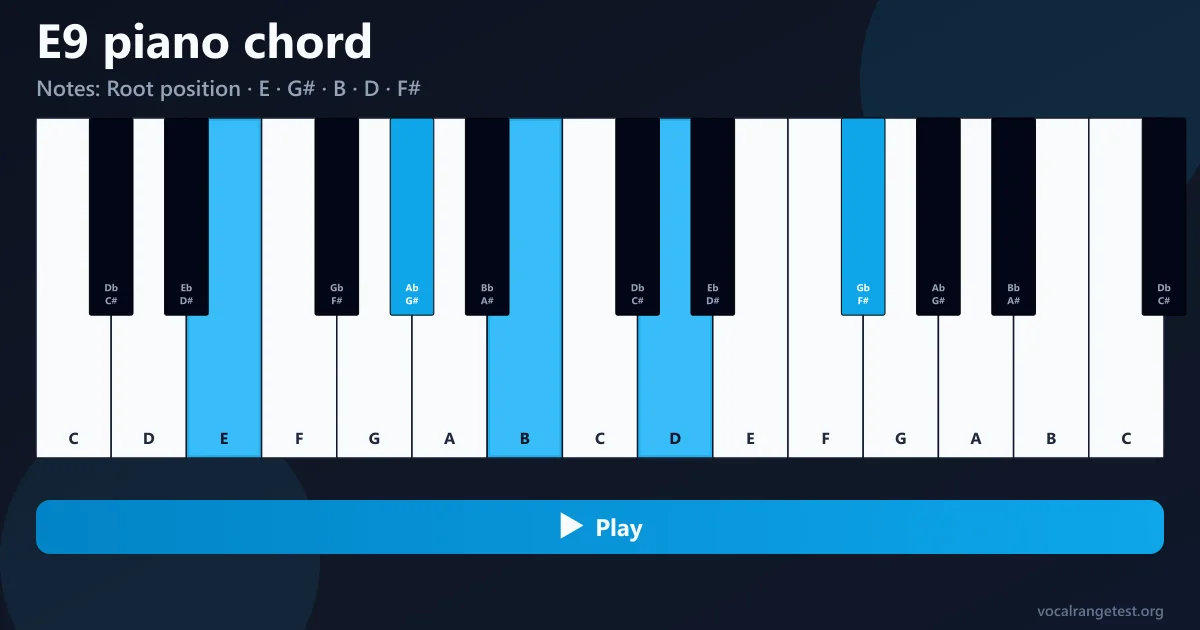
E9 on piano — G# and D keep it dominant, F# names the nine
E7 plus F# on top: E, G#, B, D, F#. G# is the major third — the black key between G and A. Without it you are not in E9 territory. D is the flat seventh that makes the chord want to move (toward A in major, or back around the blues form). F# is the ninth the symbol promises. E7 players add one tone; triad players should slow down on G# before worrying about the top note.
Eadd9 adds F# to an E triad but skips D — sweet, not dominant. Emaj9 uses D# instead of D — major-ninth colour, different tug. E7 drops F#. Those neighbours sit one key apart, which is why block-and-arpeggio beats a static JPEG. Compare E9 to E7 and Emaj9 in one click; run arpeggio when G bleeds into G# or when D never speaks.
G natural is the habit; G# is the chord
Arpeggio from E: after E comes G#, not G. That black key is what keeps the stack from sounding like Eadd9 or a wrong triad. Pair with block mode against E7 — the third is the first note that separates «close» from «right».
E blues home colour vs A-major dominant
Same five notes, two common jobs. On an E blues, E9 can dress the I chord for a verse. In A major, it is the V before A — wider than E7, same direction. Listening for context beats memorizing one grip for both.
E9/D and the gospel two-hand spread
E9/D puts D in the bass with E, F#, G#, and B above — seventh under the stack while the symbol stays E9. For comping, left E and B plus right D, F#, G# spreads seventh, ninth, and third across the right hand; arpeggio runs left then right, low to high.
Interactive E9 — hear the third, not just the diagram
Labels on a poster do not prove G# sounded or that D was in the chord. Block and arpeggio on real samples, voicing thumbnails, and hand fingerings let you verify G#, D, and F# before the wrong shape becomes default.

Block for colour, arpeggio for G# and D
Block chord delivers the full gospel/R&B wash in the selected voicing. Arpeggio when G# might be G, when D is buried under E, or when an old E7 grip never reaches F#. Keys light in play order; two-hand layout highlights bass E and B, then the right-hand cluster — not both thumbs together on beat one.
- Sampled piano — block or arpeggio, free in the browser
- Root, E9/D, and a practical two-hand voicing
- Left- and right-hand fingerings that follow the voicing
- Thumbnail grid to audition shapes before you commit
- Five pitch classes: E, G#, B, D, and F#
How to play E9 chord on piano

1. Know where E9 shows up — A major V or E blues colour
Before grips: in A major, E9 often replaces E7 as the chord that resolves to A. On an E blues, it can sit on I with more polish than E7. Same notes — different weight in the form. Pick a tune you know and notice which job the chart asks for.

2. Arpeggio checkpoint: G#, then D, then F#
E, G#, B, D, F# — run them on this page. G# is the black key between G and A; G natural is the classic wrong third. D must speak for dominant function; F# for the nine in the name. Guitar shapes do not copy literally to piano spacing.

3. E9/D when the bass line holds D
Select E9/D: D lowest, E, F#, G#, B above. Walking bass and inner voices often sit on the flat seventh while harmony reads E9. Block and arpeggio each once — darker floor, F# still on top.

4. Two-hand spread when the band is loud
Left E and B. Right D, F#, G# — seventh, ninth, third. Gospel keyboards and funk comping use this open layout so the chord clears a mix. Typical fingering left 5–1, right 1–2–3. Slow arpeggio: bass first, then the right-hand colour.

5. Root position for the ordered stack
E up through F# on the diagram — homework, and hearing the ninth above the seventh. Reference only for most gigs; take songs to E9/D or the two-hand spread.
6. Slash on the chart? Match and listen here
Lead sheets swap root, E9/D, and spread voicings. Closest layout on this page, one arpeggio pass — let your ear veto G natural and a missing D before the next rehearsal.